2015 · Top Dawg / Aftermath / Interscope · 3rd Studio Album
16 Tracks1 Running Poem1 Tupac Interview0 Living Interviewers
The album contains a running poem that builds line by line across every track and culminates in a conversation with a man who died in 1996. The interview with Tupac Shakur was assembled from a rare 1994 Swedish radio recording. Lamar asks the questions. Tupac answers from beyond the grave. The last question receives silence.
"I remember you was conflicted, misusing your influence."
Opening line of the poem. Spoken on every track.
01
The origin story
"I came to bring the pain, hardcore from the brain"
Wesley's Theory, track 1
After good kid, m.A.A.d city turned Kendrick Lamar into one of the most talked-about rappers in America, every industry expectation pointed in one direction: do it again. Make another cinematic Compton narrative. Give radio something it could use. Kendrick went the other way entirely.
The decision was not rebellion for its own sake. It was a response to what fame had actually felt like. The good kid tour had taken him away from Compton and dropped him into arenas, late-night shows, press junkets and the machinery of celebrity. He described the experience as disorienting in a way he had not predicted. He had rapped for years about surviving Compton. He had not written a word about surviving success.
The sessions began with a deliberate choice: no rap producers. Kendrick wanted live musicians in the room. He reached out to a network of jazz players based in Los Angeles who had been quietly building something extraordinary in the same years he was building his career. Thundercat on bass. Kamasi Washington on saxophone. Robert Glasper on keys. Terrace Martin on production. Flying Lotus overseeing the whole sonic universe. When they gathered to record, the sessions did not feel like a rap album being made. They felt like a jazz club that had let a poet in.
The result was an album that could not be reduced to a genre. It was jazz, funk, soul, spoken word, political sermon, confessional and elegy simultaneously. It was also the most deliberately difficult major-label rap album released since the 1990s, and it debuted at number one.
2012
good kid, m.A.A.d city
The album that made Kendrick inescapable. A cinematic double album about growing up in Compton, complete with skits, voicemails and a linear narrative. Critics called it a masterpiece. Labels called it a crossover. Kendrick called it the end of one chapter.
2013
The Control verse
On a Big Sean track, Kendrick named every major rapper in hip-hop and declared himself king of New York and the generation. The industry froze. Responses came from everywhere. It was the moment everyone understood the scale of his ambition.
2013-2014
Fame as subject matter
On tour and in interviews, Kendrick began talking about survivor's guilt in a new register. Not survival of Compton violence, but the specific dislocation of leaving poverty behind while people you love are still inside it. The album was already forming.
2014
Meeting Mats Nileskar in Germany
Swedish radio journalist Mats Nileskar met Kendrick at a festival in Germany. He told Kendrick he had conducted a now-rare 1994 interview with Tupac Shakur. The conversation that followed became the most important collaboration on the album.
2014
Sessions with the jazz collective
Thundercat, Kamasi Washington, Robert Glasper, Terrace Martin and Flying Lotus begin working with Kendrick. The sessions feel nothing like a conventional rap recording. The musicians improvise. Kendrick writes in the room. The album builds in real time.
Early 2015
iTunes leak two weeks early
TDE accidentally uploaded the finished album to iTunes before the release date. It was available for purchase for several hours. Rather than pull it, the label pushed the official release forward. The album arrived in the world unannounced, without a proper rollout, and went to number one anyway.
March 2015
Official release
To Pimp a Butterfly arrives. It is immediately recognised as something unusual. The word "Alright" begins appearing on protest signs within weeks of release, at Black Lives Matter demonstrations that Kendrick had nothing to do with organising.
02
The musicians who built the room
"Every time I'm in the studio, I spend the night, yeah"
King Kunta, track 4
Four musicians defined the sound of this album. None of them are rappers. All of them were already building one of the most significant jazz scenes in decades before Kendrick arrived.
Bass
Thundercat
Stephen Bruner had already released two solo albums of his own when he came to these sessions. His bass playing does not stay in the pocket. It wanders, questions, argues. On tracks like "These Walls" it is as melodic as the vocal. He plays bass the way the album thinks.
Lead bass throughout
Saxophone
Kamasi Washington
Washington released his own triple album, The Epic, the same year as To Pimp a Butterfly. He had been the musical director for the sessions. His saxophone is a second narrator: where Kendrick delivers political fury with words, Washington delivers it with brass. He is most devastating on "u."
Musical director
Keys
Robert Glasper
Glasper had already built a career bridging jazz and hip-hop before these sessions. His keyboard textures give the album its emotional temperature changes. The transition from warmth to dread on "For Sale?" is Glasper making you feel the shift before the lyrics tell you what it means.
Harmonic architecture
Production
Terrace Martin and Flying Lotus
Martin handled the moment-to-moment arrangement of the live sessions. Flying Lotus brought the electronic and experimental instincts that prevented the album from becoming a nostalgia exercise. Together they created something that sounds historical and futuristic at once.
Production framework
03
The running poem
"I had a dream the other night"
Mortal Man, track 16 -- the poem completes
Across every track on the album, Kendrick recites another line of a spoken word poem. It begins on track one with a single sentence. Each subsequent track adds a new line. The poem builds invisibly through the album until it is finally recited in full at the end of the final track, "Mortal Man," before the conversation with Tupac begins. Most listeners do not notice the structure until they hear it complete.
The poem is a letter. It is written to someone unnamed, describing a journey from confusion to understanding, from misused influence to clarity about what Black art owes to the people it claims to represent. By the time the final line is delivered, the poem has become a thesis for everything the album has been trying to say. Then Tupac responds.
The poem -- assembled across 16 tracks
Track 01"I remember you was conflicted, misusing your influence"
Track 02"Sometimes I did the same, abusing my power full of resentment"
Track 03"Resentment that turned into a deep depression"
Track 04"Found myself screaming in the hotel room"
Track 05"I didn't wanna self destruct"
Track 06"The evils of Lucy was all around me"
Track 07"So I went running for answers"
Track 08"Until I came home"
Track 09"But that didn't stop survivor's guilt"
Track 10"Going back and forth trying to convince myself the stripes I earned"
Track 11"Or the hurt I felt, but what was dumb was how I thought all of this was supposed to bring me closure"
Track 12"You turn my pain into power"
Track 13"But I'll tell you what's false -- making someone feel small so you can feel whole"
Track 14"And I always said it wasn't in my heart to do it"
Track 15"But what I've learned is that fear is only a relative thing"
Track 16"When I sit on the stand, I'll forever understand that we are the music and the music is us."
The full poem runs approximately four minutes when read without interruption. Most listeners hear it only in fragments, embedded between songs, until the final track delivers it whole. The structure turns the album itself into a single act of reading.
04
The Tupac interview
"If I go tomorrow, that's what I want them to remember about me"
Tupac Shakur, Mortal Man -- from the 1994 Swedish radio interview
Mats Nileskar was a Swedish radio journalist who had conducted a wide-ranging interview with Tupac Shakur in 1994. The recording was rare. It had not been commercially released. Nileskar and Kendrick met in Germany in 2014 during a festival. Kendrick told him what he was trying to build. Nileskar understood immediately.
The idea was precise: Kendrick would ask questions into the recording. Then Nileskar's Tupac audio would be edited so that Tupac's archived answers appeared to respond directly to what Kendrick was asking. Not a deepfake. Not a fabrication. A construction, carefully assembled from words Tupac had actually said, arranged to create a dialogue that felt like it was happening in real time between two men separated by two decades and death.
Tupac's mother Afeni Shakur and stepbrother Mopreme Shakur both heard the finished version before the album was released and approved its use. That approval mattered. It meant the conversation was not a stunt. It was a continuation.
Kendrick Lamar asks Tupac Shakur (1994)
Kendrick
"I wanted to ask you about the people. If a time ever came when our people were at their most vulnerable, how do you think they'd do?"
Tupac
"I think that we would start to realise the importance of unification. I think there's a chance that if we see each other as family, everything would be better."
Kendrick
"And if I'm the representative of that, if I'm the one who's been chosen to lead that movement, what advice would you give me?"
Tupac
"That no matter what you always keep fighting. No matter what, you always keep trying to make it better. See, I learned from the Black Panther Party, you never stop being a revolutionary."
Kendrick
"I have a question... and the question is: do you think if it came down to it, the people who follow you, the ones who believe in everything you say, would they be there for you?"
-- silence --
Tupac's words run out. The archive has nothing left that fits the question. The tape ends. The album ends. The last question receives no answer.
The silence at the end of the conversation is not an editing decision. It is the condition of all such dialogues. Every generation of Black artists speaks to the last. The last generation cannot always answer.
05
The songs -- what most people miss
"Alls my life I has to fight"
Alright, track 7
Five songs. Not the surface readings. The things underneath.
01
King Kunta
Track 4
The most immediate song on the album. Its funk is aggressive in a way that sounds like celebration but is actually something harder. Kunta Kinte was the enslaved African whose foot was cut off in Roots after he tried to escape. Kendrick takes that name and wears it as armour: I still have power, even what was taken from me. The chorus is about recognising sycophants who arrive when you're famous and disappear when you're not. "Now I run the game, got the whole world talking." But the name in the title tells you the price of that run.
02
Alright
Track 7
Nobody planned for this to become an anthem. Kendrick did not write it as a protest song. He wrote it as a personal affirmation, a repetition of faith in the face of evidence that faith is unreasonable. When Black Lives Matter protesters began chanting its hook at demonstrations, it was not because the song is triumphalist. It is because the song understands that saying "we gon' be alright" when you are not alright yet is a political act. Pharrell produced it. The beat sounds like a threat delivered in a whisper. The joy in the delivery is an argument with despair, not an escape from it.
03
u
Track 6
The most uncomfortable track on the album. Lowercase title, deliberately. Where its companion piece "i" is a public declaration of self-love, "u" is what Kendrick says to himself alone in a hotel room. He plays a drunk, self-destructive version of himself, raging at the image in the mirror. The accusations are specific: you left Compton behind, you got famous, people at home are dying and you are on tour. The production disintegrates around the vocal. Kamasi Washington's saxophone sounds like it is grieving. This is the album's most honest song and its hardest to listen to.
04
The Blacker the Berry
Track 14
The most controlled fury on the album. The title quotes the novelist Wallace Thurman: "the blacker the berry, the sweeter the juice." Kendrick inverts it, explores it, then turns it on himself. He spends the entire song cataloguing the violence and hypocrisy directed at Black Americans, building to an indictment of the systems that enable it. Then the final line arrives: an accusation aimed inward, at Black-on-Black violence, at the cost of fighting the outside and destroying each other inside. The song earns the right to make that accusation because of everything that came before it in those four minutes. Most songs that try this fall apart. This one holds.
05
Mortal Man
Track 16
The last song is a question: when things fall apart, will the people who followed you still be there? Kendrick asks his listeners directly whether their love is conditional on his success. He recites the complete poem. He talks to Tupac. The final question is left unanswered. The album ends in silence, as all honest questions must.
06
The lore layer
"I put the butter on your wings before you knew butterflies existed"
Mortal Man, track 16
The protest anthem nobody planned
"Alright" and the movement
Weeks after the album's release, a Fox News segment ran a clip of protesters at a Black Lives Matter demonstration chanting the hook from "Alright." The segment framed this as inflammatory. What they had captured, without understanding it, was the moment a song escaped its author and became communal property. Kendrick had written it as a private affirmation. He had not coordinated with any protest organisation. He had not donated it as an anthem. The protesters heard something in it that functioned as what they needed. The song became evidence of a property that great political music has always had: it does not tell you what to feel, it confirms what you already feel, and makes it speakable.
The butterfly on the cover
Photographed in front of the White House
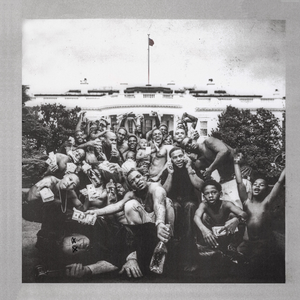
The album cover shows a group of Black men celebrating on the White House lawn, holding up champagne and cash, a judge collapsed in front of them, a young man's face pressed up against the camera. In the foreground of the image, barely visible, is a monarch butterfly. It was photographed on the White House lawn during a real visit. The butterfly was not staged. It landed, was photographed, and became part of the most loaded image in rap album history. The White House was Barack Obama's White House. That context is not incidental.
The early leak
TDE uploads the album to iTunes two weeks early
Top Dawg Entertainment accidentally made the finished album available for purchase on iTunes before the official release date. It was live for several hours before anyone noticed. Instead of pulling back and resetting the campaign, the label simply moved the release date forward. The album entered the world without a conventional rollout, without pre-release singles being serviced to radio, without the apparatus that major labels use to generate momentum. It debuted at number one anyway. The accident became proof that the music did not need the machine.
Afeni and Mopreme
Tupac's family approved the conversation
Before the album was released, Kendrick played the final track for Afeni Shakur, Tupac's mother, and Mopreme Shakur, his stepbrother. They heard a construction: Tupac's 1994 words arranged to respond to questions Kendrick was asking in 2014. They approved its use. That decision transformed what could have been a controversial stunt into something that carried the weight of family blessing. Afeni died in May 2016, little more than a year after the album's release. The conversation on "Mortal Man" is one of the last things she heard her son's voice do.
07
What it's really about
"With my skin, I walk in my skin"
The Blacker the Berry, track 14
The album operates on three thematic layers simultaneously. Most listeners spend their whole relationship with it on one. Here are all three.
Layer one
Survivor's guilt -- Compton to fame and back
The most personal layer. Kendrick grew up in Compton watching people die and disappear and be locked away. He became famous while they did not. "u" is the clearest expression of it: the specific horror of making it out when making it out means making it out alone. The album is partly an extended reckoning with what is owed to the people you leave behind, even if you did not choose to leave them.
Layer two
Blackness as burden and superpower
The political layer. "Alright" becoming a protest anthem was not an accident. The album is saturated with the specific experience of Black Americans navigating a country that simultaneously idolises and destroys Black culture. The butterfly of the title is a metaphor for transformation that costs you something: you have to leave the caterpillar behind. The question is who gets to decide when the transformation is complete.
Layer three
The conversation with the dead
The deepest layer. Every generation of Black artists talks to the last. Kendrick talks to Tupac. Tupac talked to Marvin Gaye. Marvin Gaye talked to Curtis Mayfield. The conversation never ends because the conditions that necessitated it have not ended. The silence at the end of "Mortal Man" is not the end of the conversation. It is the space where the next generation will put their own question.
08
The tracklist
Sixteen tracks. Eighty-three minutes. The poem builds across all of them. Hear it as one continuous thing.
Amber = featured song (section 05)Purple = poem added, then dialogue
#
Title
What you might not know
1
Wesley's Theory
Features George Clinton. Begins with a monologue from Dr. Dre about money traps in the industry. The poem starts here: one line.
2
For Free? (Interlude)
A spoken word explosion over aggressive free jazz. Sounds like a fight. Is one. Kendrick arguing with capitalism about the price of his body and his talent.
3
King Kunta
The most radio-accessible track on the album. Also about having your foot cut off to prevent escape. The funk is doing double work.
4
Institutionalized
Snoop Dogg appears as the voice of comfort and complacency: "You used to love being broke." The featured song structure explores what success does to the people around you, not just to you.
5
These Walls
A surface narrative about sex that is actually about prison walls and the incarceration of a man whose murder Kendrick witnessed as a child. The metaphor is revealed in the final verse.
6
u
Lowercase. Kendrick alone in a hotel room, drunk, accusing himself of everything the album's political exterior is too composed to say. The most exposed song here.
7
Alright
Pharrell production. Became the anthem of the Black Lives Matter movement without being written as one. The joy in it is a survival strategy, not a denial of conditions.
8
For Sale? (Interlude)
Kendrick is seduced by "Lucy" (Lucifer / the music industry / fame). The most sensually produced track on the album, which is the point. The seduction is supposed to feel good.
9
Momma
Kendrick returns to Compton after touring South Africa and realises he learned more about himself from a child in Johannesburg than from a year of press interviews in America.
10
Hood Politics
Compton gang politics mapped onto Washington DC politics. The argument: the two systems are structurally identical. Both require loyalty over principle. Both punish defection. Both run on debt.
11
How Much a Dollar Cost
Named Barack Obama's favourite song of 2015. A man refuses to give a dollar to a homeless person and discovers the man is God. The theology is precise. The shame is specific.
12
Complexion (A Zulu Love)
Rapsody features. About colourism within Black communities. The most tender song on the album. Love as political stance.
13
The Blacker the Berry
Four minutes of controlled fury that turns its accusation inward on the final line. Most commentators only heard the indictment of America. The final line was aimed somewhere else.
14
You Ain't Gotta Lie (Momma Said)
Samples Snoop Dogg's "Lodi Dodi." A song about authenticity and the performance of Blackness in a market that rewards performance over truth.
15
i
Originally released as a single with a cleaner arrangement. The album version is a live recording of a performance that breaks down mid-song into a history lesson. The chaos is the point.
16
Mortal Man
The poem completes. The interview with Tupac runs. The final question goes unanswered. The album ends in silence.
Sources
The Oral History of To Pimp a Butterfly, Recording Academy / Cuepoint (2015). Robert Glasper, Slate interview (2015). Billboard: How Kendrick Transformed into the John Coltrane of Hip-Hop (2015). MusicRadar: Making To Pimp a Butterfly (2015). Mats Nileskar / P3 Soul original Tupac interview (1994). Vice: Full Tupac Interview Audio (2015).
IF YOU LIKED THIS
Read these next
Albums about conversations with the dead, concept albums that reveal their structure at the end, and music as political act.