Album deep read

Kid A Radiohead

2000  ·  Parlophone  ·  4th Studio Album
10 Tracks 5 Members 1 Million Secret Booklets 0 Singles Released

After OK Computer made them the biggest rock band in the world, Radiohead responded by destroying everything that had made them successful. No singles. No music videos. No guitar solos. No clear vocals. Just ten tracks that sounded like the future arriving too early.

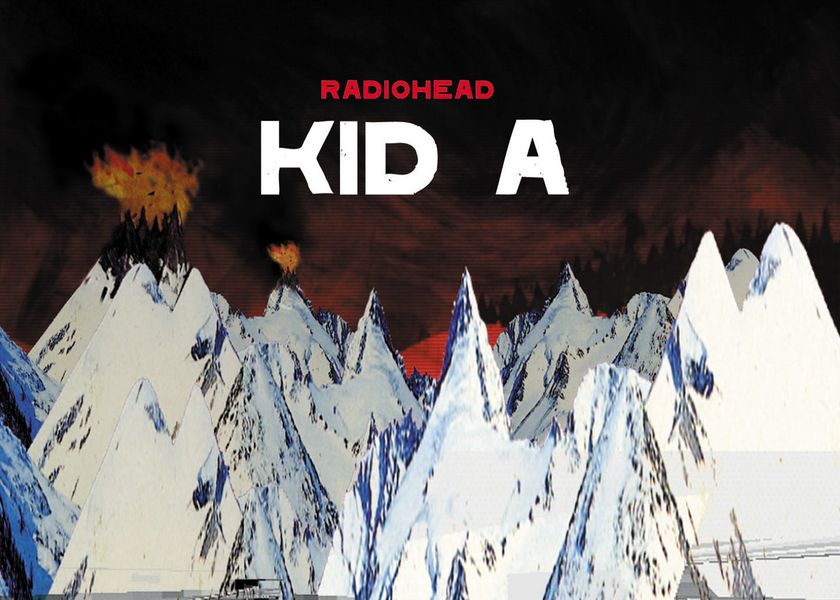
Kid A - Radiohead album artwork by Stanley Donwood, apocalyptic painted landscape
"I completely had it with melody. I just wanted my voice used as an instrument rather than having a leading role."
- Thom Yorke
01
The origin story
"Everything in its right place"
Everything in Its Right Place, track 1

Following the OK Computer tour, Thom Yorke went through a period of profound creative struggle. He described it as "the most unpleasant period I've ever been through." He had writer's block so severe that his new songs consisted of little more than sounds, rhythms, and fragments. Few had verses or choruses. The structures that had built OK Computer felt contaminated by what the album had become.

Recording began January 1999 at Guillaume Tell Studios in Paris with producer Nigel Godrich. It continued across studios in Copenhagen, Gloucestershire, and Oxfordshire through April 2000. The band argued constantly. According to Godrich, Yorke barely communicated. According to Yorke, Godrich "didn't understand why, if we had such a strength in one thing, we would want to do something else." The arguments about the tracklist reportedly brought the band close to breaking up.

Yorke's solution was to process his voice beyond recognition. His vocals were fed through a ring modulator, vocodered through Jonny Greenwood's Ondes Martenot (an early electronic instrument from the 1920s), and scrubbed in Pro Tools. On "Everything in Its Right Place," the voice is simultaneously human and machine. You can hear the words but they arrive from somewhere unfamiliar.

The label received the finished album and was reportedly alarmed. No singles were released. No traditional music videos were made. Instead, the band commissioned dozens of 10-second "blips" of Stanley Donwood artwork and aired them on music channels without context or explanation.

Kid A debuted at number one in the UK and, to everyone's shock, number one in the US, where Radiohead had never had a number one album. It did this without a single being released.

Apr 1998
OK Computer tour ends
104 shows. Yorke enters a period of creative struggle he would later describe as the hardest he had ever experienced.
Jan 1999
Recording begins
Guillaume Tell Studios, Paris. Godrich producing. Band barely speaking. Songs arrive as sounds and fragments rather than structured compositions.
Mid 1999
The Ondes Martenot
Greenwood teaches himself the 1920s instrument. Yorke's voice is fed through it, emerging as something between human and electronic signal.
Late 1999
The arguments
Tracklist disputes nearly break the band. Two albums' worth of material emerges. What becomes Kid A and what becomes Amnesiac are separated in the editing room.
Apr 2000
Recording finishes
Across four studios in four countries over sixteen months. The label is alarmed. No singles are planned.
Oct 2, 2000
Released
No singles. No videos. Blips only. Debuts at number one in the UK and the US. Changes what a rock album is allowed to be.
02
The instruments inside it
"Yesterday I woke up sucking a lemon"
Everything in Its Right Place, track 1

Kid A sounds like it does not because of what the band added, but because of how they dismantled their own instruments. Four machines made the album possible. None of them were guitars.

Invented 1928
Ondes Martenot
One of the earliest electronic instruments. Jonny Greenwood taught himself to play it. It produces a wavering, ethereal tone controlled by a ribbon and a ring. On Kid A, Yorke's vocals were literally fed through it. The voice enters one instrument and emerges as something between human and electronic signal. The most alien sounds on the album are a 1920s machine processing a human throat.
Electronic instrument
Built 1978
Prophet-5 Synthesizer
In Gloucestershire, Yorke and Godrich transferred songs onto the Prophet-5, an analogue synthesizer that predated digital synthesis. Songs written on guitar were rebuilt from scratch on a machine that was already twenty years old when they recorded it. The warmth inside the coldness of Kid A comes from analogue circuitry, not algorithms.
Analogue synthesizer
Misused tool
Pro Tools Scrubbing
Yorke's vocals on several tracks were processed using Pro Tools' scrubbing function, a tool designed for finding edit points, not for making music. The glitching, stuttering quality on tracks like "Kid A" is a creative misuse of editing software. The album's most futuristic sound effect is a word processor looking for a cursor position.
Digital misuse
Live manipulation
Modular Electronics
Greenwood assembled a rack of modular electronics and signal processors. The crackling, breathing textures that sit underneath the album, what sounds like a radio dying in an empty room, are live manipulations of electronic noise. Not samples. Not plugins. Physical signal chains with no memory of how they were configured.
Signal processing
03
The lore layer
"We're not scaremongering. This is really happening."
Idioteque, track 8
Physical object
The hidden booklet: one million secret messages
The first one million pressings of Kid A contained a secret. Beneath the CD tray, hidden unless you removed the disc and lifted the plastic, was a 48-page booklet of Stanley Donwood artwork. The designs are political diatribes. One bears an image of Tony Blair surrounded by nonsense text. Another documents melting glaciers with clinical precision. Another is a map of genetically modified crop sites across Britain. None of this is mentioned on the packaging. You had to find it yourself.
One million copies. One million hidden messages. Most were never discovered by the people who bought them. The booklet was not a bonus feature. It was a test of attention. Radiohead made a political document and buried it inside a commercial product to see who would look.
The sample
Idioteque and the 1973 mainframe
"Idioteque" is built on a sample from "Mild und Leise" by Paul Lansky, a 1973 computer music composition created at Princeton. The sample is a four-chord sequence generated by a mainframe computer. Greenwood wrote to Lansky asking permission. Lansky listened and responded that he found the use "imaginative and inventive." The most futuristic-sounding track on the album is built on a piece of music older than most of the band members, made by a computer that no longer exists.
Anti-marketing
The blips: 10 seconds without context
Instead of music videos, Radiohead commissioned dozens of 10-second animated clips featuring Donwood's artwork. They were aired on MTV and music channels without explanation, branding, or context. Viewers had no idea what they were advertising. The blips were the anti-marketing campaign for an anti-album. Radiohead used the infrastructure of the music industry to broadcast messages the music industry could not decode.
The tour structure
The tent tour: No Logo in practice
To promote Kid A, Radiohead toured Europe inside a custom-built tent. No corporate sponsors. No advertising anywhere on the structure. The tent concept was inspired by Naomi Klein's No Logo, the anti-globalization book that was reshaping how artists thought about commercial culture. They played the album inside a structure designed to exist outside the system the album was critiquing. The venue was the message.
The artwork
Donwood's paintings: parallel apocalypse
For Kid A, Stanley Donwood and Yorke abandoned their previous methods of collage, photography, and digital manipulation and used paint for the first time. Donwood: "I got these huge canvases and went mental using knives and sticks to paint with." The apocalyptic red and white landscapes on the cover, swimming pools on fire, mountains collapsing, were painted while listening to the album being made. The artwork is not illustration. It is a parallel response to the same experience. Two people absorbing the same source material and producing different forms of the same collapse.
04
The songs: what most people miss
"Yesterday I woke up sucking a lemon"
Everything in Its Right Place, track 1

Five songs. Not the track descriptions. The things underneath.

01
Everything in Its Right Place
Track 1
The album's manifesto. Yorke's voice is processed into a machine texture using the Ondes Martenot. The chords were played on an analogue keyboard, not a guitar. The opening track announces a position: guitars are gone, melody is suspect, the human voice is now another signal in the mix. What sounds peaceful is a declaration of war against the album that preceded it.
02
Kid A
Track 2
The title track. Yorke's voice is so heavily processed it becomes another instrument entirely. The lyrics were cut up using a technique borrowed from William Burroughs and Brion Gysin. Words were pulled from a hat and assembled randomly. What sounds like a lullaby from inside a collapsing computer is also a song about which words survive when you remove the intention to mean anything.
03
The National Anthem
Track 3
A bass riff recorded in the early 1990s, topped with a brass section instructed to improvise freely and not listen to each other. The chaos is not accidental. It is directed chaos. Musicians told to ignore the rules of ensemble playing. The result sounds like a civic ceremony coming apart at the seams, which is precisely what the song is about.
04
Idioteque
Track 8
The Paul Lansky sample underneath everything. Yorke's vocal, one of the few on the album with clearly audible lyrics, is a warning about climate collapse delivered as a dance track. "Ice age coming, ice age coming." Written in 2000. The Arctic ice sheet has lost more than 13% of its area since the song was recorded. The most prescient thing on an album full of prescient things.
05
How to Disappear Completely
Track 4
The phrase Yorke wrote on a hotel window during the OK Computer tour became a full song. "I'm not here, this isn't happening." The Ondes Martenot provides the orchestral swell. Greenwood plays it as an act of care. Yorke has called it "the most beautiful thing we've ever done." It is the only song on Kid A that sounds like consolation. The album hides it in the middle, where you have to earn it.
05
What it's really about
"Ice age coming, ice age coming. Let me hear both sides."
Idioteque, track 8

Kid A operates on three levels simultaneously. Most listeners catch one.

Layer one
The destruction of rock
Kid A was a deliberate act of self-sabotage. The biggest guitar band in the world removed the guitars, buried the vocals, and refused to release singles. It was a statement that comfort is the enemy of art. The most valuable thing Radiohead owned in 2000 was their audience's trust. They spent it immediately, with no plan to recover it. The album went to number one anyway.
Layer two
Information overload
Yorke was consuming Naomi Klein, Noam Chomsky, and climate science. The album's glitching, fragmentary sound mirrors a mind overwhelmed by data. Too much information arriving too fast to process into coherent thought. The lyrics are fragments because that is how information feels when there is more of it than any one person can hold. Kid A is the sound of a brain at capacity.
Layer three
Climate grief before it had a name
"Idioteque" describes ice caps melting. The hidden booklet documents GM crops and glacier loss. Donwood's artwork depicts landscapes on fire. In 2000, this was fringe anxiety. By 2020, it was the news. Kid A was climate art before climate art existed as a category. The album knew something and could not make anyone believe it in time.
06
The tracklist

Ten tracks. Forty-seven minutes. No singles. The full sequence, as it was intended to be heard.

Red = featured breakdown Blue = instrument focus Slate = ambient / no vocal
#
Title
What you need to know
1
Everything in Its Right Place
Voice as machine. Guitar replaced by keyboard. The manifesto. Yorke's split vocal samples are from the same source recording played back at different speeds.
2
Kid A
Cut-up lyrics assembled from a hat. Burroughs technique. A lullaby inside a collapsing computer. The title of the album is the name of the song Yorke could barely sing.
3
The National Anthem
Brass section told not to listen to each other. Directed chaos. The bass riff predates the band by years, waiting for a song to grow around it.
4
How to Disappear Completely
The OK Computer hotel window note becomes a song. Greenwood's Ondes Martenot provides the swell. The most beautiful thing they ever made, hidden in the middle where you have to find it.
5
Treefingers
Ed O'Brien's guitar processed beyond recognition into ambient texture. No drums. No vocals. The album exhales here before continuing. The only track where you can hear the room itself.
6
Optimistic
The closest thing to an OK Computer-era guitar song. "The big fish eat the little ones." Jonny Greenwood plays a guitar part that sounds like it is being swallowed.
7
In Limbo
The album's most anxious track. Guitars that sound like they are drowning. Yorke sings "I'm lost at sea" over a rhythm that refuses to resolve.
8
Idioteque
Paul Lansky's 1973 Princeton mainframe sample underneath everything. Climate collapse as a dance track. "Ice age coming." Written in 2000. The most accurate prediction on the album.
9
Morning Bell
Written in 5/4 time. A different version appears on Amnesiac, the same song split across two albums like a cell dividing. Both versions are correct.
10
Motion Picture Soundtrack
A harmonium and a harp. The quietest ending to the loudest artistic statement of the year. Hidden silence after the track ends, then a brief coda of reversed harps that most listeners never reach.
Sources
Clash Magazine: The Making of Kid A (2000). Record Collector: Colours in My Head (2000). Citizen Insane fan archive. Louder Sound: How Radiohead Reinvented Rock with Kid A (2020). Stanley Donwood, NME interview (2000). Naomi Klein, No Logo (1999). Paul Lansky correspondence, Princeton University.
IF YOU LIKED THIS

Read these next

Albums about destroying what made you successful, electronic reinvention, and the sound of information overload.