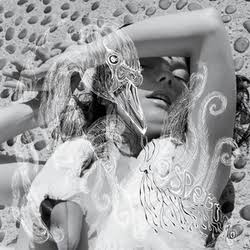
BjörkVespertine2001 · One Little Indian / Elektra · 5th Studio Album
12 Tracks8 Studios30-40 Microbeats Per Song1 Swan
She set out to make an album about making sandwiches. She ended up making an album about making love. The title change tells the whole story.
"Selmasongs was the day job. Vespertine was the hobby."
Björk
01
The origin story
"An echo, a stain"
An Echo, a Stain, track 7
The album begins with Lars von Trier. In 1999, Björk agreed to star in Dancer in the Dark, von Trier's musical about a Czech immigrant going blind in small-town America. The filming was gruelling in ways that went beyond the demands of a difficult role. Von Trier's methods were confrontational by design - he worked to break his actors down, to strip away their defences, to capture something raw and uncontrolled on camera. For Björk, who had never acted in a feature film and whose instinct was to control every detail of her creative output, the experience was devastating. In 2017, she would refer publicly to sexual harassment from "a Danish director," adding her account to the wave of disclosures that defined that year. The filming left marks that the album would spend its entire runtime trying to heal.
While being forced into extroversion on set - performing, emoting, surrendering to someone else's vision every day - she began disappearing inward. She started recording on a laptop in her trailer, quietly, between takes. The sounds were small: tapping, clicking, the hum of a computer fan, breath against a microphone. She was not making a statement. She was making a hiding place. The working title was Domestika - a record about domestic life, about everyday noises as melody, about the beauty of staying indoors. It was the opposite of everything happening around her on the film set.
The second force was Matthew Barney. American conceptual artist, filmmaker, creator of the Cremaster cycle - a series of five feature-length art films that had already made him one of the most discussed figures in contemporary art. Björk and Barney began a relationship during the period between the completion of Dancer in the Dark and the recording of what would become Vespertine. Where the von Trier experience had been about forced exposure, the Barney relationship was about chosen intimacy. Two artists whose work operated at the highest levels of ambition, finding in each other a space that did not need to perform for an audience.
The album is the collision of these two forces - pain made into privacy, and privacy made into desire. Domestika became Vespertine. From the Latin vesper, meaning evening - relating to things that bloom at dusk, that open only when the light withdraws. She set out to write about making sandwiches. She ended up writing about making love. The title change was not a rebranding. It was a confession.
1999
Filming Dancer in the Dark begins
Björk travels to Denmark to begin work on Lars von Trier's musical. The shoot will last months. She begins recording quietly on a laptop between takes - small domestic sounds, private noises, a retreat from forced extroversion.
2000
Dancer in the Dark wins the Palme d'Or at Cannes
The film premieres and wins the festival's highest prize. Björk also wins Best Actress. She swears publicly that she will never act in a film again. She keeps that promise for over two decades.
2000
Domestika sessions begin in earnest
Björk begins assembling laptop recordings, domestic sounds, and microbeat patterns into the skeleton of what she is calling Domestika. The concept: an album about staying home. About the interior as subject.
2000-2001
The relationship with Matthew Barney begins
Björk and the American conceptual artist begin a relationship that will reshape the album's emotional centre. The domestic record becomes a love record. The noises of the home become the sounds of two people in one space.
Early 2001
Sessions move to a New York loft
The recording relocates to New York City. The title changes from Domestika to Vespertine. The shift is decisive: from the domestic to the vespertine, from the everyday to what blooms in the evening, from making sandwiches to making love.
March 2001
The swan dress at the Oscars
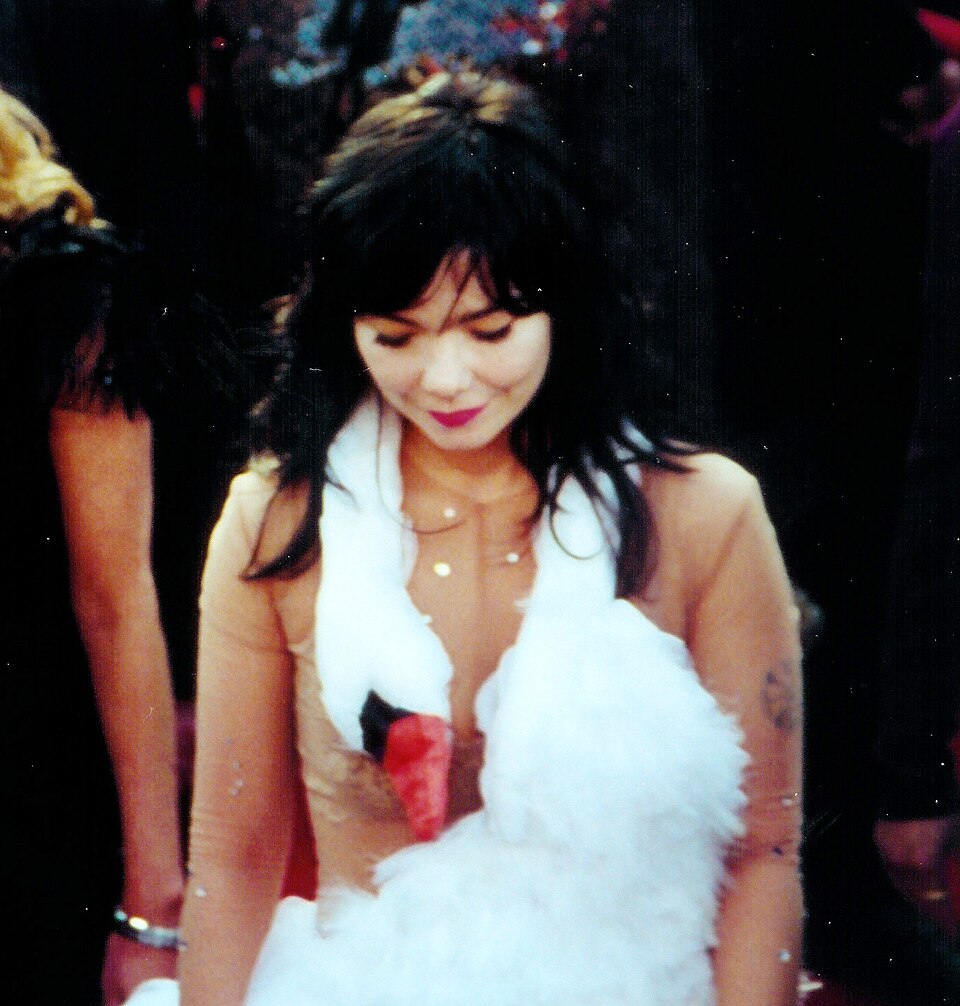
Björk attends the 73rd Academy Awards in a swan dress by Macedonian designer Marjan Pejoski. She lays an ostrich egg on the red carpet. The press calls it a disaster. She calls it "just a dress." It becomes one of the most iconic images in Oscar history.
August 27, 2001
Vespertine released
One Little Indian and Elektra release the album worldwide. Fifteen days before 9/11. An album about retreat, about finding safety in the intimate and the small, arrives just before the world decides that nothing small is safe anymore.
02
The production
"In this nest of a bedroom is where I best hide"
Hidden Place, track 1
The key setting is a New York loft in summer 2001. The windows open to heat; the music turns inward to ice. Björk worked with harpist Zeena Parkins and a small team of programmers, building her arrangements on a laptop running Sibelius notation software - the kind of tool designed for classical composers scoring orchestral works, not for someone making a pop record. She used it precisely because it was not designed for what she was doing. The software forced her to think about music as written architecture rather than performed spontaneity. Every note had to be placed. Every silence was a decision.
She recorded noises around her home to build beats. Ice cracking in a glass. Playing cards being shuffled. A laptop lid closing in a library. The rustle of fabric. The click of a light switch. These were not samples in the hip-hop sense - fragments of other people's music repurposed - but original field recordings of domestic life, captured and then processed, layered, and multiplied until they became rhythmic patterns so dense that each song contained what she described as "a microcosmos of thirty to forty beats interacting." The ear hears a gentle, floating surface. Underneath, dozens of tiny percussive events are happening simultaneously, each one derived from something you could find in a kitchen or a bedroom.
She and Marius de Vries did the core sound design in SuperCollider - a text-based audio programming language where you create sound by writing code rather than turning knobs or pressing keys. You type a command; the computer generates a waveform. You modify the command; the waveform shifts. De Vries described it as a tool that "takes you in surprising directions" because you cannot predict what a string of text will sound like until you run it. The album's texture comes from writing music as code - from treating sound as something you construct from language rather than from performance.
This is the production method of someone who has decided that the conventional studio process - musician plays, engineer records, producer mixes - is inadequate for what she wants to express. The intimacy of Vespertine required a production approach that was itself intimate: one person, one laptop, one language, building a world sound by sound from the ground up. The orchestral arrangements, the choirs, the harp - these were added later, but the foundation was always a woman alone with a computer, typing instructions to a machine, listening to what came back.
Sound engine
SuperCollider
Text-based synthesis. You type commands, not turn knobs. Marius de Vries said it "takes you in surprising directions." The album's crystalline texture comes from writing music as code - treating sound as something you construct from language rather than from performance.
Core tool
Frozen instruments
Custom Music Boxes
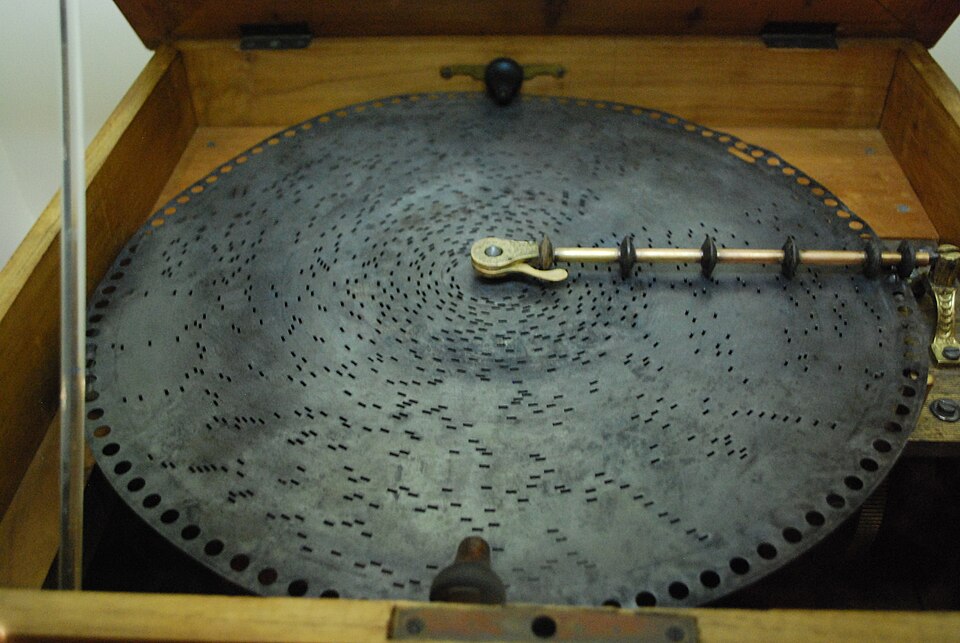
Björk commissioned custom music boxes but insisted on transparent acrylic plexiglass instead of wood. Wood softens sound; she wanted it frozen, hard, like struck ice. The company resisted, then agreed. She said: "They said it was the best thing they'd ever done."
Signature sound
Harmonic spine
Zeena Parkins (Harp)
Electric and acoustic harp woven through every track. Not decorative - structural. The harp carries the harmonic architecture that in a normal pop record would be done by guitar or synth. Parkins' playing is the skeleton the rest of the album hangs from.
Architecture
Extraordinary decision
Napster-Proof Design
Björk was aware most people in 2001 were downloading compressed mp3s on dial-up through laptop speakers. So she deliberately chose instruments whose frequencies survive compression - harp, celesta, clavichord, music boxes. One of the only records ever consciously designed around music piracy.
Ahead of its time
03
The swan
"I thought my input should really be about fertility. I thought I'd bring some eggs."
Björk, on the Oscars
The swan dress. 73rd Academy Awards. March 25, 2001.
The dress was not designed for Björk. Macedonian designer Marjan Pejoski debuted the swan dress on supermodel Alek Wek at London Fashion Week in February 2001 - a white tulle gown shaped as a full swan draped around the wearer's body, the bird's head resting on the chest, the neck curving upward as if the creature had simply decided to wrap itself around a human being. It was a runway piece. It was not intended for the Academy Awards red carpet.
Björk wore it to the 73rd Academy Awards on March 25, 2001, without telling Pejoski in advance. He found out the morning after, when the dress was already on the front page of every tabloid in the Western world. She had been nominated for Best Original Song for "I've Seen It All" from Dancer in the Dark - a song about a woman losing her sight, performed by an artist who had sworn never to act again. She did not win. She did something more interesting.
She sent staffers to find actual ostrich eggs before the ceremony. On the red carpet, she pretended to lay one - crouching, placing the egg on the ground, then walking on. Joan Rivers said she should be institutionalised. The fashion press called it the worst outfit in Oscar history. The internet, then still in its early viral phase, circulated the images for weeks. The dress the press called a disaster became the visual identity of her most celebrated album. She put the same dress on the Vespertine album cover and wore variations of it throughout the world tour that followed.
What nobody discussed at the time - and what matters more than the spectacle - is what the gesture meant in context. She had just spent a year being stripped of control by a director who used manipulation as method. She arrived at the Oscars, the most controlled and controlling event in entertainment, and chose to be completely uncontrollable. The egg was a joke about fertility and creation. The swan was a creature that is simultaneously beautiful and ridiculous. She said: "It's just a dress." It was not just a dress. It was a woman who had been forced to perform someone else's idea of vulnerability, arriving at the biggest stage in the world and performing her own version instead. The entire Vespertine project is contained in that one act of refusal disguised as absurdity.
04
The lore layer
"In between the way things are and how they should be"
Generous, track 12
The credit dispute
The Matmos credit lie
In a 2015 Pitchfork interview, Björk said something that had been building for fourteen years. She did 80% of the beats on Vespertine. It took her three years. Matmos - the experimental electronic duo of Drew Daniel and M.C. Schmidt - came in for the last two weeks of production and added percussion layers on top of structures she had already built. "They are credited everywhere as having done the whole album." Drew Daniel, to his credit, corrected the record in every interview he gave. Nobody listened. The press continued to attribute the production to Matmos because the narrative of a woman needing male collaborators to achieve technical sophistication was easier to write than the truth. Björk compared her situation to Kanye West's: nobody questions whether Kanye made his own beats. The comparison was deliberate and precise. She was asking why the same standard did not apply to her. The answer was obvious. The question was the point.
The instruments
The music boxes - frozen sound
She commissioned custom music boxes from a specialist company, but with one non-negotiable condition: acrylic plexiglass cases instead of the traditional wood. Wood absorbs and softens the resonance of the metal tines. She wanted the opposite. She wanted notes that sounded frozen - hard, brittle, crystalline, like struck ice. The company resisted. Wood was how it had always been done. She insisted. They built the acrylic boxes. They appear throughout the album - most purely on Frosti, the 90-second instrumental that functions as the record's breath between Pagan Poetry and Aurora, and most significantly on Pagan Poetry itself, where the music box melody carries the emotional weight that in any other song would be given to a vocal hook. When the company heard the finished record, she said, they told her it was the best thing they had ever done.
The name
The title change - Domestika to Vespertine
Domestika became Vespertine. The first title described the album's method: domestic sounds, household recordings, the rhythms of everyday private life. The second title described what the album had become once the method met the subject. From the Latin vesper, meaning evening - vespertine describes organisms that bloom or become active at dusk, when the world withdraws and the private hours begin. She set out to write about making sandwiches. She ended up writing about making love. The name change is the entire arc of the album compressed into a single editorial decision. Domestika was a concept album. Vespertine is a love letter. The difference between the two is the distance between documentation and confession.
05
The songs - what most people miss
"I love him, I love him"
Pagan Poetry, track 4
Five songs. Not the surface readings. The things underneath.
01
Hidden Place
Track 1 - the entrance is a whisper
The first sound is a softly thrumming electronic loop - not a statement, not a bang, not a declaration of intent. A pulse. She was "slightly shy," she said later, about the album's opening. She hides under blankets in the lyrics. The vocals are close and breathy, as if the microphone is inside the hidden place rather than observing it from outside. The beats were built from gasps - Drew Daniel of Matmos spent hours cutting 36 different inhalations from her earlier recordings to build a rhythm section entirely from the sound of a woman breathing. The percussion is literally her body. Every thump and click in the song's rhythm track is a fragment of Björk inhaling or exhaling, sliced and rearranged until the breath becomes indistinguishable from the beat. The song's subject is finding a place to disappear. Its construction method is making the singer's body the architecture of that disappearance.
02
Cocoon
Track 6 - the closest anyone has ever recorded
The most explicit song on the album. There is no metaphor. The lyrics describe sex directly - the physical sensations, the specific details of what it feels like to be inside a body that is being touched by another body. "He slides inside / Half awake, half asleep." The vocal was recorded so close to the microphone that you can hear her lips moving against the pop screen. You can hear the wetness of her mouth. A professional audio mixer would have asked for a second take - the proximity creates noise, breath artifacts, the kind of sonic debris that recording engineers spend careers learning to eliminate. They did not ask for a second take. That closeness is the point. The song exists at the exact distance between two people who are touching. The sonics are the sonics of a secret - something whispered from inches away, something you have to lean in to hear, something that was never meant to carry across a room.
03
Pagan Poetry
Track 4 - the banned video, the sewn pearls, the confession
The video was banned. Nick Knight directed. Björk operated a home camera for the explicit footage that opens the piece - blurred, abstracted images of bodies that the viewer understands without seeing clearly, the way you understand what is happening in the next room from the sounds coming through the wall. Five women were cast to have needles sew pearls directly into their skin - threads pulled through flesh, beads cascading down bare backs, the ornamentation becoming indistinguishable from the wound. The pearls cascade into an Alexander McQueen dress. MTV banned it immediately. VH1 would only air it after midnight. The music box line uses the custom acrylic instruments - you can hear exactly what she meant by frozen. The melody is simple, almost childlike, and it sits on top of a beat pattern so dense that the contrast between innocence and complexity becomes the song's emotional engine. "I love him, I love him" - repeated until the words lose their conventional meaning and become pure sound, pure need, a chant rather than a statement. It is the most naked moment in her catalog. It was punished for it.
04
Harm of Will
Track 10 - the Sarah Kane track
This is the track almost nobody discusses in Vespertine criticism, and it is the one that anchors the album's emotional argument most completely. The lyrics are drawn from Sarah Kane's play Crave, published in 1998 - a four-voice work of devastating compression about desire, abuse, and the failure of language to contain either. Kane died by suicide in February 1999, aged 28. She hanged herself at King's College Hospital in London. She had been admitted for depression. She was one of the most significant playwrights of her generation - Blasted (1995) had caused riots at the Royal Court Theatre; 4.48 Psychosis, completed before her death, is now performed worldwide. Harm of Will is one of her posthumous legacies - her language, carried into a context she did not live to hear. Björk's vocal on this track is restrained to the point of near-absence. She does not perform the lyrics. She holds them. The song is a vessel for someone else's pain, carried carefully, placed down gently. Kane is a serious literary figure. This is a serious act of remembrance.
05
Aurora
Track 11 - the disintegration
Uses the Hamrahlid Choir - an Icelandic ensemble whose voices carry the specific quality of northern light, something clear and cold and vast. The harp and music boxes that have been the album's structural spine begin to disintegrate here. The careful, precise architecture that Björk built over twelve tracks starts to loosen. Arctic imagery becomes physical - the ice that has been a metaphor throughout the record becomes an actual landscape, a place you can stand in and feel the wind. Aurora is the most underwritten track on the album - critics tend to skip past it on the way to the closing statement of Generous - but it is the moment where the album's controlled intimacy opens outward for the first time. The bedroom becomes the sky. The whispered confession becomes a choir singing across a frozen field. It is the sound of someone who has been hiding for eleven tracks finally stepping outside.
06
The aftermath - three acts
"State of emergency - how beautiful to be"
Unison, track 3
Act one
The tour
Björk toured Vespertine not in stadiums or conventional concert venues but in opera houses. She travelled with an Inuit women's choir from Greenland and the Hamrahlid Choir from Iceland - two ensembles whose voices carried the specific qualities of northern geography, of cold air and open space and light that arrives sideways. The stage was a cocoon of white fabric. She performed inside it, surrounded by singers, enclosed in a space that replicated the album's central gesture: retreat into the intimate, into the protected, into the small.
The tour was not a promotional exercise for an album. It was the album performed as environment - as a space you could physically enter and occupy for two hours. The opera house setting was deliberate. Opera is the art form where intimacy and enormity coexist most naturally, where a whispered confession can fill a 2,000-seat room without amplification. Björk had made an album of whispers. She needed rooms built for whispers to carry. The Inuit choir's vocal techniques - throat singing, shared breathing, sounds produced by two voices interacting rather than two voices performing separately - mirrored the album's construction method: small sounds made enormous through layering and interaction. The tour ran through the autumn of 2001. It began fifteen days after September 11th.
Act two
The relationship
Matthew Barney and Björk became one of the art world's most significant couples - two people operating at the highest levels of their respective fields, each with a practice so singular that collaboration between them felt less like a meeting of minds than a collision of cosmologies. Their daughter Isadora was born in 2002, the year after Vespertine's release. The album that began as a record about domestic life became, in retrospect, the prelude to an actual domestic life - one lived between Reykjavik and New York, between Iceland's volcanic landscapes and Manhattan's concrete grid.
Their most significant collaboration was Drawing Restraint 9 (2005) - a feature-length film set aboard a Japanese whaling vessel, in which Barney and Björk play two figures undergoing a ritual transformation into whales. She composed the entire score. The film is beautiful, bewildering, and almost impossible to describe in terms that make conventional sense. It is the logical conclusion of the relationship that Vespertine documents in its earliest, most private phase - two artists who found in each other a space where their most extreme impulses did not need to be explained or justified.
They separated in 2013. Björk's next album, Vulnicura (2015), would document the dissolution with a rawness that made Vespertine's intimacy look restrained by comparison. The two albums are bookends. Vespertine is the sound of falling in love. Vulnicura is the sound of that same love coming apart. Together they form a single twelve-year arc - the most sustained and honest documentation of a relationship in the history of recorded music.
Act three
The legacy
Vespertine is now considered her masterpiece by many critics - the album where every element of her practice converged into something that nobody else could have made. Homogenic (1997) was bolder. Debut (1993) was more immediately accessible. Post (1995) was more eclectic. But Vespertine is the one that sounds like nothing else, the one that created a sonic vocabulary that did not exist before it and has not been replicated since.
It anticipated ASMR culture by fifteen years. The entire online phenomenon of whispered, close-miked audio designed to create a physical tingling response in the listener - Björk was doing this in 2001, building an album-length experience around the principle that the closer a sound is recorded, the more physically present it becomes. Cocoon is functionally an ASMR recording. Hidden Place's gasp-built beats are the same technique that ASMR artists would later use to construct their videos. She did not invent the sensation. She was the first person to build an entire artistic architecture around it.
The laptop production predicted bedroom pop. In 2001, making a major-label album on a laptop was eccentric. By 2015, it was standard practice. Billie Eilish's debut was recorded in a bedroom. Clairo's first EP was made on a laptop in a dorm. The entire generation of artists who built careers from their bedrooms between 2015 and 2025 are working in a space that Björk occupied first - and occupied more radically, because she chose the laptop not as a convenience but as a philosophy.
The Napster-proofing predicted streaming. She designed the album's instrumentation to survive lossy compression - to sound correct through laptop speakers playing mp3 files downloaded on dial-up internet. In 2001, this was a response to piracy. By 2020, it was the default listening condition for most music worldwide. Everything about this album was ahead of its time. The intimacy, the laptop methodology, the frequency choices, the ASMR qualities, the refusal to separate high art from domestic life. Twenty-five years later, the rest of music is still catching up to what she built in a New York loft in the summer of 2001.
07
What it's really about
"Crystalline"
The album's operating principle
Vespertine operates on three thematic levels simultaneously. Most listeners catch one. Here are all three.
Layer one
Introversion as resistance
A retreat from Lars von Trier. A retreat from the Oscars. A retreat from the media cycle that follows a Palme d'Or win and a Best Actress nomination. Every production choice on this album - the whispered vocals, the domestic sound sources, the laptop recording, the refusal to give interviews during the promotional cycle - is an act of withdrawal. Not passive withdrawal, not collapse, but deliberate, architectural withdrawal. She is drawing a circle and saying: not in here. The world can do what it wants outside this room. Inside, the ice cracks in the glass and the cards shuffle and the music box plays its frozen melody and nobody else is invited. Introversion as resistance means that the most radical thing a public figure can do, sometimes, is to become private. To refuse the stage. To make an album that rewards headphones and punishes stadiums. To build a masterpiece out of staying home.
Layer two
The domestic as radical
Not about the world. About a room. A record about staying home, built on a laptop, designed to survive piracy, constructed from the sounds of ice and fabric and breath - and it was one of the most technically adventurous records of its decade. The feminist reading writes itself and she eventually made it explicit: she did 80% of the beats. It took three years. Men got the credit. The domestic sphere - the kitchen, the bedroom, the space where sandwiches are made - is treated here as serious artistic subject matter, not as backdrop or metaphor but as the thing itself. She took the private sphere seriously as a source of beauty and as a space worthy of the most sophisticated production techniques available. This was not a lo-fi bedroom record. This was a hi-fi bedroom record. The distinction is the entire point.
Layer three
The body as architecture
Swan dress to Pagan Poetry to Cocoon video. Pearls sewn through skin. Red threads from nipples. An egg laid on the red carpet. Vocals recorded millimetres from the microphone so you can hear the body producing the sound. Beats built from 36 of her own gasps. The microbeats from ice and shuffling cards are sounds of fragile structures holding, occasionally giving way - the sound of material under stress, of something crystalline that could shatter if you pressed too hard. The album is about what it feels like to be inside a body that is inside a love. Not love as emotion but love as physical architecture - as a structure you inhabit, a building made of skin and sound and the specific temperature of someone else's breath against your neck at three in the morning. The body is not a metaphor on this album. It is the instrument, the subject, the recording studio, and the audience. Everything begins and ends in the body.
08
The tracklist
Twelve tracks. Fifty-five minutes. One woman, one laptop, one love. Hear it as a single whispered confession.
Ice blue = featured song (section 05)Rose = lore track
#
Title
What you might not know
1
Hidden Place
Beats built from 36 of her own gasps. Drew Daniel spent hours cutting and rearranging fragments of Björk's inhalations from earlier recordings to construct the entire rhythm track from the sound of her breathing.
2
It's Not Up to You
Guy Sigsworth arrangement. The string writing anticipates what Jonny Greenwood would later do for Paul Thomas Anderson's films - orchestral textures that function as atmosphere rather than melody, that surround the vocal rather than supporting it.
3
Undo
Zeena Parkins' harp at its most prominent. The melody is a lullaby structure played at half-speed - slowed until the comfort of the form becomes something stranger, something that rocks you to sleep in a room where the temperature is dropping.
4
Pagan Poetry
Banned MTV video. Custom acrylic music boxes. Pearls sewn through skin. Nick Knight directed. Alexander McQueen dress. Five women, needles, thread. The most extreme visual statement of her career, paired with the album's most vulnerable vocal performance.
5
Frosti
90-second instrumental. Music boxes only. A breath between Pagan Poetry and Aurora - the album's palate cleanser, its moment of pure sound without language, without confession, without the weight of meaning. Just frozen notes in an acrylic box.
6
Cocoon
Recorded millimetres from the microphone. The most intimate recording in her catalog. You can hear her lips against the pop screen. A professional mixer would have asked for a second take. They didn't. That closeness is the point.
7
An Echo, a Stain
Guy Sigsworth. The most orchestrally spare moment on the record - a song that strips away the microbeat layers and the harp filigree and leaves the vocal more exposed than anywhere else except Cocoon. The title is the album in miniature.
8
Sun in My Mouth
Lyrics adapted from an E.E. Cummings poem: "i like my body when it is with your body." Cummings wrote it in 1925. Björk set it to music boxes and electronic pulses seventy-six years later. The poem survived the translation intact.
9
Heirloom
A lullaby for her son Sindri. The microbeats here are gentler than anywhere else on the album - the density is still present, but the edges are softer, the frequencies warmer. A mother singing to her child through a wall of crystalline sound.
10
Harm of Will
Lyrics drawn from Sarah Kane's play Crave (1998). Kane died by suicide aged 28 in February 1999. One of the most significant playwrights of her generation. This is one of her posthumous legacies. Almost never discussed in Vespertine criticism.
11
Aurora
Hamrahlid Choir. Arctic disintegration. The album's careful architecture begins to loosen here - the controlled intimacy of eleven tracks opens outward into something vast and cold and beautiful. The bedroom becomes the sky.
12
Generous
The closing statement. Written last. The title is the album's final word and its summary: after fifty-five minutes of retreat, of hiding, of whispering, of building frozen architectures around a love - the last thing she says is generous. An offering. A gift.
Sources
Björk, Pitchfork interview (2015). Mark Pytlik, Björk: Wow and Flutter (2003). Marius de Vries, SuperCollider production interviews. Drew Daniel (Matmos), various interviews 2001-2015. Sarah Kane, Crave (1998). Marjan Pejoski, London Fashion Week records.
IF YOU LIKED THIS
Read these next
Albums about electronic reinvention, intimate electronics, and anonymous bedroom production.