Recorded 1966 to 1967 | Capitol Records | Released 2011 as The Smile Sessions
37 Years Unfinished400,000 Covers Printed1 Session Stopped by FireA "Teenage Symphony to God"
After Pet Sounds, Brian Wilson decided to make the greatest album ever recorded. He had a method nobody had used before, a lyricist who wrote in American mythology, and a concept he called a "teenage symphony to God." He stopped a session because he believed his music had caused a building to catch fire. Capitol printed 400,000 covers. He finished it 37 years later.
"It was just putting together a jigsaw puzzle on a wall instead of a tabletop. It kept falling."
Brian Wilson, I Am Brian Wilson, on assembling SMiLE
01
The origin story
"I'm writing a teenage symphony to God"
Brian Wilson, to friends, 1966
Pet Sounds had changed everything. Not commercially, where it underperformed in America, but critically and artistically. Paul McCartney heard it and called "God Only Knows" the greatest song ever written. The Beatles felt the pressure and responded by making Sgt. Pepper. Brian Wilson heard what he had done and decided to make something larger.
He told friends he was working on a "teenage symphony to God." A concept album that would encompass American history, the natural elements, youth, innocence, humour, and the spiritual. He had a collaborator: Van Dyke Parks, a songwriter and arranger whom Byrds member David Crosby had introduced to Wilson in December 1965. Parks would write the lyrics. Wilson would build the music around them.
The Rivalry
Pet Sounds vs. Pepper's
Wilson made Pet Sounds in response to Rubber Soul. Now both bands were racing toward the same territory: the concept album as a total artistic statement, the studio as an instrument.
Explicit competition
The Method
Modular Recording
Wilson had discovered a technique with "Good Vibrations" that allowed him to build songs from independent fragments recorded separately and assembled later, like a film editor cutting scenes.
Six months per song
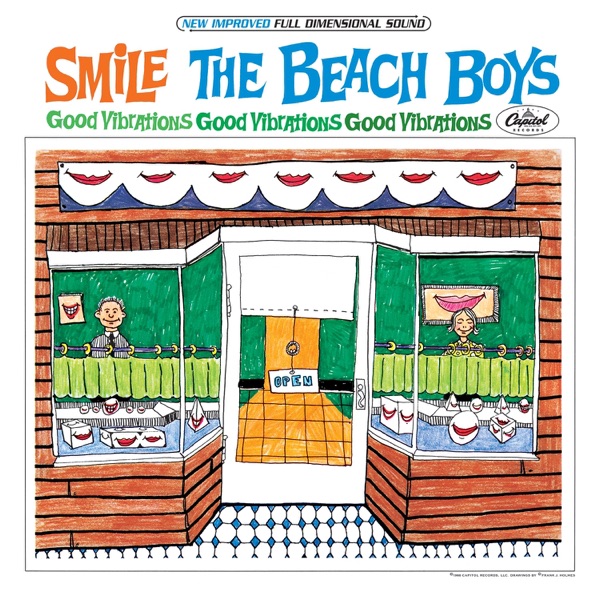
Capitol Records was informed and enthusiastic. The label ran advertisements announcing the album. They printed 400,000 covers with the Frank Holmes illustration of a whimsical Americana street scene. They scheduled the release for January 1967. In August 1966, "Good Vibrations" was released as a single. It became the best-selling Beach Boys record ever and their first US number one in three years. The momentum was extraordinary.
The album was scheduled for January 1967. It never came out.
May 1966
Pet Sounds released
Wilson's masterpiece lands to mixed American reviews and strong UK reception. Paul McCartney calls "God Only Knows" the greatest song ever written. The Beatles begin work on Sgt. Pepper's in direct response.
February 1966
First "Good Vibrations" session
The modular recording method is born. Wilson begins building from independent fragments across multiple studios. The process will take six months.
December 1965
Wilson meets Van Dyke Parks
David Crosby introduces them at a party. Wilson asks Parks to write lyrics for the new album. Their collaboration produces some of the strangest and most beautiful words in American pop.
October 1966
"Good Vibrations" released, SMiLE sessions begin
The single reaches number one in the US and UK. Capitol runs trade ads announcing SMiLE for January 1967. Wilson is in the studio daily.
March 1967
Parks leaves the project
Creative tensions escalate. Without Parks, Wilson cannot integrate his own lyrics into the existing fragments. Sessions stall. Capitol grows anxious.
May 1967
SMiLE cancelled
Wilson pulls the plug. Sgt. Pepper's is released on June 1 to global acclaim. The 400,000 pre-printed covers sit in a Capitol warehouse. The session tapes go into storage.
02
The method
"We wanted it to sound like a continuum, because I like it when music flows"
Brian Wilson, Paste magazine, 2004
Nobody had made a pop album this way before. Wilson's modular method treated musical fragments as interchangeable building blocks. A horn arrangement might become the bridge of one song, then the introduction of another, then disappear entirely if the sequence changed. A vocal phrase could be transplanted between tracks. The editing techniques he had developed for "Good Vibrations" were extended to encompass the entire album simultaneously.
The sessions drew on the Wrecking Crew, the elite Los Angeles session musicians who appeared on most of the decade's landmark records. There was no written score for most of the recordings. Wilson would describe what he was hearing, demonstrate it at the piano, and watch the musicians find it. He recorded fragments of each piece across multiple sessions, in different studios, sometimes on different days, sometimes months apart.
The Musicians
The Wrecking Crew
Hal Blaine on drums. Carol Kaye on bass. Larry Knechtel on keyboards. Session musicians who appeared on the decade's defining records. Wilson used no written scores.
No written score
Van Dyke Parks
The lyricist
Dense, allusive, literary American mythology. "Do You Like Worms?" describes Plymouth Rock to Hawaii as a meditation on American history and its violence. Mike Love hated the lyrics.
Mythology as pop
The album was conceived in three movements representing Americana, the cycle of life, and spiritual rebirth. Within those movements, individual tracks were to flow into each other without gaps. An uninterrupted suite, the way classical music worked. Wilson described it as wanting "a continuum, because I like it when music flows."
The problem was that building something this large from fragments with no fixed sequence is not a problem that resolves itself. It resolves when the artist decides it is resolved. Wilson could never settle on the sequence. "He would just keep rearranging," recalled one collaborator. "I would beg Brian not to change a piece of music because it was too fantastic, and then he'd move it into something else." Wilson never decided.
03
The collapse
"In 1967, the reasons why I didn't finish Smile was Mike didn't like it, I thought it was too experimental"
Brian Wilson, Grunge.com interview
The failure of SMiLE was not one event. It was an accumulation. Wilson's drug use had been escalating throughout the sessions: marijuana, LSD, Desbutal. It amplified both his creativity and his paranoia. He was working in a state of heightened sensitivity where he could hear things in the music that others could not.
He became increasingly reclusive. He ordered eight truckloads of sand delivered to his home studio so he could wiggle his toes in it while he composed. He wore a fireman's helmet while recording the "Fire" track, which he had built from drums, strings, and whistles to evoke an actual conflagration. The eccentricities were partly creative method and partly the escalating effects of LSD. They were producing results. The fragments from this period are among the most innovative pop recordings of the decade.
The sandbox
Eight Truckloads of Sand
Wilson wanted to maintain a physical connection to the beach and to California while building the most ambitious music of his career. He sometimes composed in a tent he had erected inside the studio.
Tactile composition
The fire session
Mrs. O'Leary's Cow
A building near the studio caught fire. Wilson became convinced his music had caused it. He attempted to burn the master tape, only to find that analog tape does not burn easily. He interpreted this as evidence of supernatural protection.
Faith in destruction
Mike Love's opposition to the project was sustained and explicit. He told Van Dyke Parks directly that the lyrics were too obscure. He preferred the Beach Boys' established identity as a California pop group to the esoteric Americana mythology Parks was constructing. His objections were heard and resented.
Whether Love's objection was decisive is contested. What is clear is that it was not helpful. Parks left in March 1967 after creative tensions became irresolvable. Without Parks, Wilson could not integrate his own lyrics into the existing musical fragments. Sessions began to cancel on short notice. One was cancelled at a cost of 3,000 dollars because Wilson felt bad vibrations.
Then Sgt. Pepper's arrived in June 1967 and was greeted as the masterpiece of the age. Wilson heard it and was devastated. He pulled the plug on SMiLE. The album it had been racing against had won the race by default.
04
The lore layer
"What word comes after 'cheering'?"
Brian Wilson, calling Van Dyke Parks out of nowhere, 2003
The phone call
Thirty-seven years of silence, then a single question
In 2003, while working through old SMiLE material with keyboardist Darian Sahanaja, Wilson encountered a lyric sheet with handwriting he couldn't fully read. He needed to know what word came after "cheering" in "Do You Like Worms?" He phoned Van Dyke Parks, whom he had not spoken to in years. He asked immediately: "What word comes after 'cheering'?" Parks requested a fax of the lyric sheet, called back within minutes with the answer: "Indians." Then Wilson called again for a longer conversation. Parks accepted the invitation to finish what they had started. Sahanaja said: "Brian would sing a melody, and I wouldn't know if it was new or something that had always been there. Van Dyke would listen, look up, and then point up in the air and nod his head, like confirmation of some thread he'd left behind."
The bootleg community
Fans assembled the album before Wilson could
Throughout the 1980s and 1990s, session tapes leaked and circulated among collectors. A community of fans including musicians Darian Sahanaja, Probyn Gregory, and Nick Walusko spent years compiling reconstructions from whatever fragments were available. When Capitol released the Good Vibrations box set in 1993, the liner notes told listeners: "Remember, what you're listening to are unfinished productions, fragments, demos and tracks. With a programmable CD player you can make your own order." Forty years before streaming algorithmic playlists, Wilson had inadvertently invented the user-assembled album.
The race it lost
Sgt. Pepper's and the feedback loop
The Wilson-McCartney rivalry is the defining creative tension of 1960s pop. Wilson made Pet Sounds in response to Rubber Soul. McCartney heard Pet Sounds and called "God Only Knows" the greatest song ever written. The Beatles made Sgt. Pepper's partly in response to Pet Sounds. Wilson heard Sgt. Pepper's and abandoned SMiLE. Two albums, two bands, feeding each other across the Atlantic. Sgt. Pepper's won because it was finished. What SMiLE would have been, had Wilson been able to assemble it in January 1967 before Pepper existed, is a question that has never been answered and will not be.
05
The songs what most people miss
"I heard the word / Wonderful things"
Wonderful, from the SMiLE Sessions
Five pieces. Not analysis of recordings that were finished. Readings of what the fragments were trying to do.
01
Surf's Up
The centrepiece
Wilson recorded a solo piano and vocal version in December 1966 for a CBS television special. He performed it alone at a concert grand, singing Parks' abstract lyrics in an unaccompanied arrangement of startling vulnerability. The show's producer described it as "poetic, beautiful even in its obscurity" and "too complex to get all of first time around." Parks said it was the piece he was most proud of. Wilson agreed it was the best thing they wrote together. It is a song about the end of innocence, told through imagery of ocean and sky and something irrecoverable disappearing below the horizon.
02
Heroes and Villains
The single
The only SMiLE song completed and released at the time, as a single in July 1967. What the public heard was not what had been recorded. Wilson had assembled a version from the modular fragments that ran to several minutes and encompassed multiple musical sections. What was released was significantly shortened. The box set shows a song that existed in dozens of versions, none of them identical. The song is about the American West, cowboys and settlers and the mythology of violence that founded the continent.
03
Do You Like Worms? (Roll Plymouth Rock)
The history song
Parks described the lyrical concept as an east-to-west journey from Plymouth Rock to Hawaii. The entire arc of American westward expansion compressed into a pop song. The lyrics include: "Roll Plymouth Rock / Roll over / We'll over-run the Indians." This was the line Mike Love objected to. Parks refused to change it. The music Wilson built underneath is a rolling, cycling composition that shifts between tempos and feels, like the land itself changing.
04
Mrs. O'Leary's Cow (The Elements: Fire)
The track Wilson tried to destroy
An orchestral instrumental evoking fire through purely musical means. No samples, no recordings of actual flames, just drums and strings and brass building into something genuinely alarming. Wilson recorded it wearing a fireman's helmet. After a building near the studio caught fire, he became convinced his music had caused it and attempted to burn the master tape. It won the Grammy for Best Rock Instrumental Performance in 2005. The piece of music that frightened Wilson most became his finest instrumental work.
05
Good Vibrations
The proof of concept
Technically released before the SMiLE sessions as a stand-alone single, but built using the same modular method and from some of the same sessions. The recording exists in over 80 hours of recorded material across multiple studios. Wilson assembled it over six months from fragments that were never intended to sit in fixed positions. The 2011 box set devoted an entire disc to its recording history alone. It is the clearest demonstration of how the modular method worked and what it could produce. He was right about the method. The assembly was what broke him.
06
The aftermath three acts
"We thought we were too far ahead of our time"
Brian Wilson, BBC News, 2011
Act one
Smiley Smile and the years of retreat
The Beach Boys still needed to release an album. Carl Wilson described what happened: "Brian just said, 'I can't do this. We're going to make a homespun version of it instead. We're just going to take it easy. I'll get in the pool and sing.'" The homespun version was recorded in six weeks in Wilson's makeshift home studio. It peaked at number 41 in the US, the band's lowest chart position to that point. Over the following decade, Wilson retreated from the band's creative centre. Fragments of SMiLE material surfaced on subsequent albums as filler. SMiLE had not just failed to be released. It had taken its author with it.
Act two
Brian Wilson Presents SMiLE, 2004
In late 2003, Wilson, Parks, and keyboardist Darian Sahanaja assembled the session fragments into a three-movement structure. Parks contributed newly written lyrics for sections that had never been completed. Wilson's backing band, the Wondermints, rehearsed the material and performed the world premiere in London in February 2004 to five sold-out shows and multiple standing ovations. The 2004 version was a new recording using Wilson's current band, not the original 1966 to 1967 session tapes. Wilson won a Grammy for Best Rock Instrumental Performance for "Mrs. O'Leary's Cow." The piece of music he had tried to destroy in 1967 won him the award.
Act three
The Smile Sessions, 2011
Capitol Records released The Smile Sessions: the original 1966 to 1967 recordings, assembled as closely as possible to Wilson's original intentions, across five CDs. Two of those discs were devoted entirely to the recording histories of "Heroes and Villains" and "Good Vibrations" alone, demonstrating the scale of the modular method and how many versions of each fragment existed. SMiLE is now generally regarded as one of the most significant recordings in American popular music. It has also shaped modern production in ways that were not visible when it was being made. The modular recording method Wilson developed became, via Pro Tools and digital audio workstations, the standard approach to album production. Every contemporary producer who assembles a track from independently recorded fragments is working in the tradition Wilson invented by accident in 1966, wearing a fireman's helmet, trying to make the greatest album ever recorded.
07
What it's really about
"Columnated ruins domino"
Surf's Up, Van Dyke Parks lyric
The album operates on three levels simultaneously. The combination of all three is why it has never stopped being discussed.
Layer one
America as mythology
Parks wrote the lyrics as a meditation on American identity. Not the America of the Beach Boys' early surf-and-cars output, but the America of Plymouth Rock and westward expansion and the violence that founded it. "Columnated ruins domino" is not nonsense poetry. It is a description of civilisations falling one into the next. The album was to travel from Plymouth Rock to Hawaii, east to west, following the American arc.
Layer two
Ambition as trap
Wilson could hear the finished album. He described it consistently and in detail. The problem was not vision. It was assembly. The modular method that made the individual pieces extraordinary made sequencing impossible. Every arrangement produced something different and every arrangement was provisional. He could not decide because every decision unmade another one.
Layer three
The legend as the work
There is an argument that SMiLE's unfinished status is not a failure but the condition that makes it what it is. Every listener who has encountered the bootlegs, the fragments, the multiple reconstructions, has assembled their own version. What exists now is an album that belongs to whoever assembles it. That was not what Wilson intended. It is what the work became.
08
The tracklist
The sequence below follows the 2011 Smile Sessions reconstruction, itself based on the 2004 Brian Wilson Presents SMiLE arrangement. No sequence is definitive. Every version of this tracklist is someone's decision about what Wilson intended. Wilson himself prefers his 2004 recording.
Gold = featured songBrown = released in altered form in 1967
#
Title
What you should know
1
Our Prayer / Gee
An a cappella vocal invocation opening the album. The combination sets the tone: something reverent and something playful, both at once.
2
Heroes and Villains
The only SMiLE song released at the time, as a single in July 1967 in shortened form. About the American West and the mythology of conquest. Mike Love hated the lyrics.
3
Do You Like Worms? (Roll Plymouth Rock)
The entire arc of American westward expansion in a pop song. Wilson recalled the verse melody across 37 years without hearing it. One of two pieces where his original intentions remained intact in memory.
4
I'm in Great Shape / Barnyard
Two fragments combined. The "Barnyard" section features animal noises performed by the band. A deliberate piece of Americana humour.
5
Cabin Essence
One of the few SMiLE tracks released in a form close to its original intent, appearing on the 20/20 album in 1969. A meditation on the frontier and what was lost in settling it.
6
Wonderful
A song about childhood innocence losing its shape. Appeared on Smiley Smile in a stripped-down version that Parks described as "toothless" compared to the original.
7
Look (Song for Children)
A children's song that functions as the threshold between the album's innocence and its more complex second movement. What children hear and what adults hear are not the same thing.
8
Child Is Father of the Man
The title from Wordsworth. The theme of innocence passing into experience. Parks' lyric is one of his most compressed. The music is among the most complex harmonic writing Wilson produced.
9
Surf's Up
Wilson performed it alone at the piano for a 1966 CBS television programme. The album's emotional and artistic centre. A meditation on something beautiful ending.
10
Vega-Tables
Paul McCartney visited the studio during the April 1967 sessions and participated in vegetable-crunching for the track. Whether his voice is on the final recording is unverifiable.
11
Wind Chimes
The Water section of the Elements suite. A piece of such ambient delicacy that it sounds like something Brian Eno would make a decade later.
12
Mrs. O'Leary's Cow (The Elements: Fire)
Recorded while Wilson wore a fireman's helmet. He believed the music started a fire near the studio and tried to destroy the tape. It won the Grammy for Best Rock Instrumental Performance in 2005.
13
Love to Say Dada
The final note of the SMiLE sessions was recorded on May 18, 1967. The backing track for this song. Then Wilson stopped. There is a poetry in that if you choose to find it.
14
Good Vibrations
Released before the SMiLE sessions as a stand-alone single, but built by the same method and from some of the same sessions. The most successful Beach Boys single ever. The album it was meant to anchor never came out.
Sources
Wikipedia, Smile (The Beach Boys album). Wikipedia, Brian Wilson Presents Smile. Wikipedia, The Smile Sessions. Wikipedia, Surf's Up (song). Wikipedia, Smiley Smile. Brian Wilson, I Am Brian Wilson (memoir). TIME Magazine, "The Legacy of Brian Wilson's Smile Album." American Songwriter, "The Beach Boys Give up on Smile in 1967." Journal on the Art of Record Production, "SMiLE: Brian Wilson's Musical Mosaic." Grunge.com, "The Strange and Tragic Story Behind the Beach Boys' Album Smile." Inside Pop: The Rock Revolution (1967, CBS). Glorious Noise, "Brian Wilson's Annotated Surf's Up Lyrics." The Paul McCartney Project, "Vega-Tables Session Apr 10 1967." The Smile Sessions deluxe box set liner notes, Capitol Records (2011). Good Vibrations: Thirty Years of The Beach Boys box set liner notes (1993). Darian Sahanaja, various interviews. Brian Wilson Presents Smile (2004), Nonesuch Records.
IF YOU LIKED THIS
Read these next
Albums built from ambition that exceeded its container, and records that took decades to find their moment.