13 Tracks4 Beatles1 Alter Ego700 Hours in the Studio
On a flight from Nairobi in November 1966, Paul McCartney asked road manager Mal Evans what the S and P stood for on the in-flight salt and pepper packets. That conversation became the name of the most influential album in the history of popular music.
"We were fed up with being the Beatles. We really hated that four little mop-top approach. We were not boys, we were men."
- Paul McCartney
01
The origin story
"It was twenty years ago today"
Sgt. Pepper's Lonely Hearts Club Band, track 1
The Beatles stopped touring on 29 August 1966 after their final show at Candlestick Park, San Francisco. George Harrison was heard to say: "Right, that's it, I'm not a Beatle anymore." They were exhausted, creatively frustrated, and trapped inside a fame machine they could no longer control.
McCartney's solution arrived on a plane. Flying back from Kenya with Mal Evans, he started imagining an alter ego - a fictional band that would free them from being the Beatles. "As we're trying to get away from ourselves, how about if we become an alter-ego band, something like Sgt. Pepper's Lonely Hearts Club Band?" The S and P came from the sauce packets on the meal tray. Evans and McCartney riffed on it for the rest of the flight.
Recording began 24 November 1966 in Studio Two at EMI Studios, now Abbey Road Studios. For the first time, they had no deadline and no budget limit. Sessions started at 7pm and ran as late as they wanted. Engineer Geoff Emerick was 20 years old. Producer George Martin was given instructions that would have been impossible in any previous era of pop music. Between them, they spent approximately 700 hours in the studio - compared to the 585 minutes it took to record their debut, Please Please Me, in a single day.
EMI visited the sessions and left unhappy. When they heard the finished album, they quietly lowered their sales forecasts, calling it uncommercial and difficult to market. It debuted at number one in every country it was released in.
Aug 29, 1966
Final live show
Harrison: "I'm not a Beatle anymore" at Candlestick Park. The band walked off stage and never played a ticketed concert again.
Nov 1966
The plane
McCartney conceives the alter ego on a flight from Kenya with Mal Evans. The name comes from salt and pepper packets on the meal tray.
Nov 24, 1966
Recording begins
EMI Studios, Studio Two. No deadline, no budget limit. Emerick is 20. Martin is given instructions nobody has given a producer before.
Jan 1967
A Day in the Life
Sessions begin on what will become the album's centrepiece. A 40-piece orchestra is booked for Studio One. McCartney wanted 90 musicians.
Feb 10, 1967
The crescendo
McCartney wanted 90 musicians. Got 40. Recorded the orchestral climb four times and stacked all four takes. The result lasts 24 bars and covers two octaves.
Mar 21, 1967
The acid trip
Lennon takes LSD by accident during a "Getting Better" session. Martin takes him to the roof for air, unaware of what Lennon has taken.
Apr 21, 1967
The inner groove
Gibberish recorded, tape cut up and reassembled at random. A dog whistle tone is added to the runout after "A Day in the Life".
Jun 1, 1967
Released
Debuted at number one worldwide. EMI had forecast modest sales. The album sold 250,000 copies in its first week in the UK alone.
02
Abbey Road as collaborator
"I'd love to turn you on"
A Day in the Life, track 13
Geoff Emerick was 20 years old and was doing things nobody had done before. EMI had strict rules about microphone placement. Emerick broke all of them. He close-miked Ringo's drums for the first time in EMI history. He ran vocals through a Leslie speaker cabinet. He pioneered the use of direct injection on a Beatles session. EMI built their own DI boxes for the sessions, possibly the first anywhere in the world.
The studio had a standard EMI REDD desk, eight channels in and four out, with Studer 4-track tape machines. Everything on this album was achieved on four tracks. They bounced and re-bounced, losing a generation of fidelity each time but gaining something no one had heard before.
Direct Injection
Plugged Straight In
Bass plugged directly into the desk for the first time on a Beatles session. EMI built their own DI boxes. Possibly the first use of direct injection anywhere in the world.
First use
Leslie Speaker
The Warbling Sound
Vocals and instruments fed through a rotating speaker cabinet designed for Hammond organs. The underwater warbling quality on "Lucy in the Sky with Diamonds" is this technique.
Vocals + Instruments
Automatic Double Tracking
The Drifting Voice
Ken Townsend invented ADT at Abbey Road because Lennon hated manually double-tracking his vocals. The slightly offset voice that drifts in and out of the mix is ADT.
Townsend invention
Tape Manipulation
Cut, Throw, Splice
Loops, speed changes, backward recordings throughout. The fairground atmosphere of "Mr. Kite" was created by cutting organ tape into strips, throwing them in the air, and splicing randomly.
Mr. Kite technique
03
The cover
"A splendid time is guaranteed for all"
Being for the Benefit of Mr. Kite!, track 7
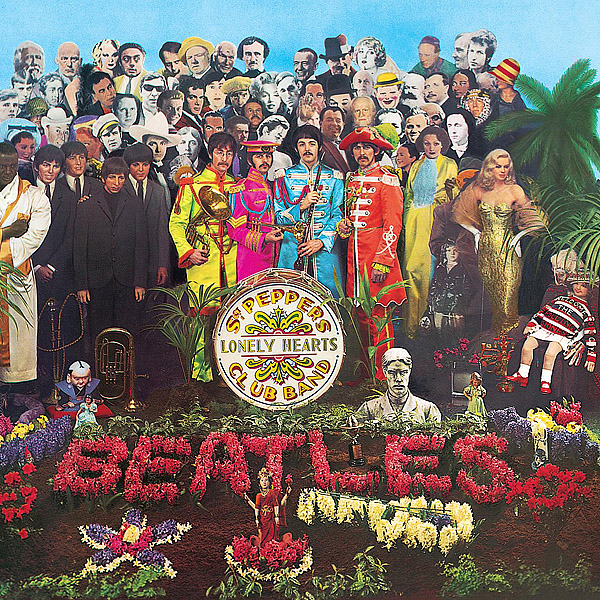
The most expensive album cover ever made at the time. Final cost: 2,868 pounds - roughly 39,000 pounds today and 100 times the average. Peter Blake and Jann Haworth were paid 200 pounds. Blake has called this a sore point ever since.
The concept: the Beatles in new Sgt. Pepper uniforms, standing before a crowd of their heroes as life-size cardboard cutouts and wax figures borrowed from Madame Tussauds.
Who was rejected: Lennon wanted Hitler and Jesus. EMI said no. Gandhi was modelled and placed to the right of Lewis Carroll, then removed for fear of offending the Indian market. Leo Gorcey demanded 400 pounds for his image rights and was airbrushed out after the band refused.
Who made it in: 57 photographs plus wax Madame Tussauds Beatles, plus the four real Beatles in their new uniforms. The crowd includes Marlene Dietrich, Edgar Allan Poe, Karl Marx, Marilyn Monroe, Bob Dylan, Aleister Crowley, Lewis Carroll, Marlon Brando, Oscar Wilde, and Mae West - who initially asked "What would I be doing in a lonely hearts club band?" and relented only after the Beatles wrote her a personal letter.
The inserts: Original pressings included a moustache, sergeant stripes, two badges, a picture card, and a stand-up cutout. The album was meant to be interactive. Most surviving cutouts have been lost.
04
The lore layer
"I read the news today, oh boy"
A Day in the Life, track 13
The inner groove
After the silence - a loop that plays forever
After "A Day in the Life" ends, after the dog whistle, after the silence - on the original UK vinyl there is something else. A two-second loop of gibberish pressed into the runout groove. On turntables without auto-return, it plays forever. Created on 21 April 1967. Two passes of nonsense were recorded, the tape was cut into pieces, reordered randomly, and spliced back with no intended message. Played in reverse, some listeners claim to hear obscene phrases. McCartney said: "Believe me, this wasn't intentional." It was omitted from all American pressings. The loop still plays on every copy of the original UK vinyl in existence.
The dog whistle
Above human hearing - audible to dogs
After the final chord of "A Day in the Life", a tone at approximately 15 to 18 kilocycles - above human hearing but audible to dogs. Added deliberately. On high-fidelity equipment you detect a faint high-pitched whine. On modest equipment, nothing at all. Your dog hears it every time.
Lucy's real name
Julian's painting - not about drugs
Three-year-old Julian Lennon came home from nursery school with a painting of his classmate surrounded by stars. He said: "That's Lucy in the sky with diamonds." The real Lucy - Lucy Vodden - lived in Surbiton, Surrey. As a teenager she was told the song was about drugs, not her. She didn't particularly like it. She passed away from lupus on 28 September 2009, aged 46. Julian had renewed their friendship before she died. The original drawing is now owned by David Gilmour of Pink Floyd.
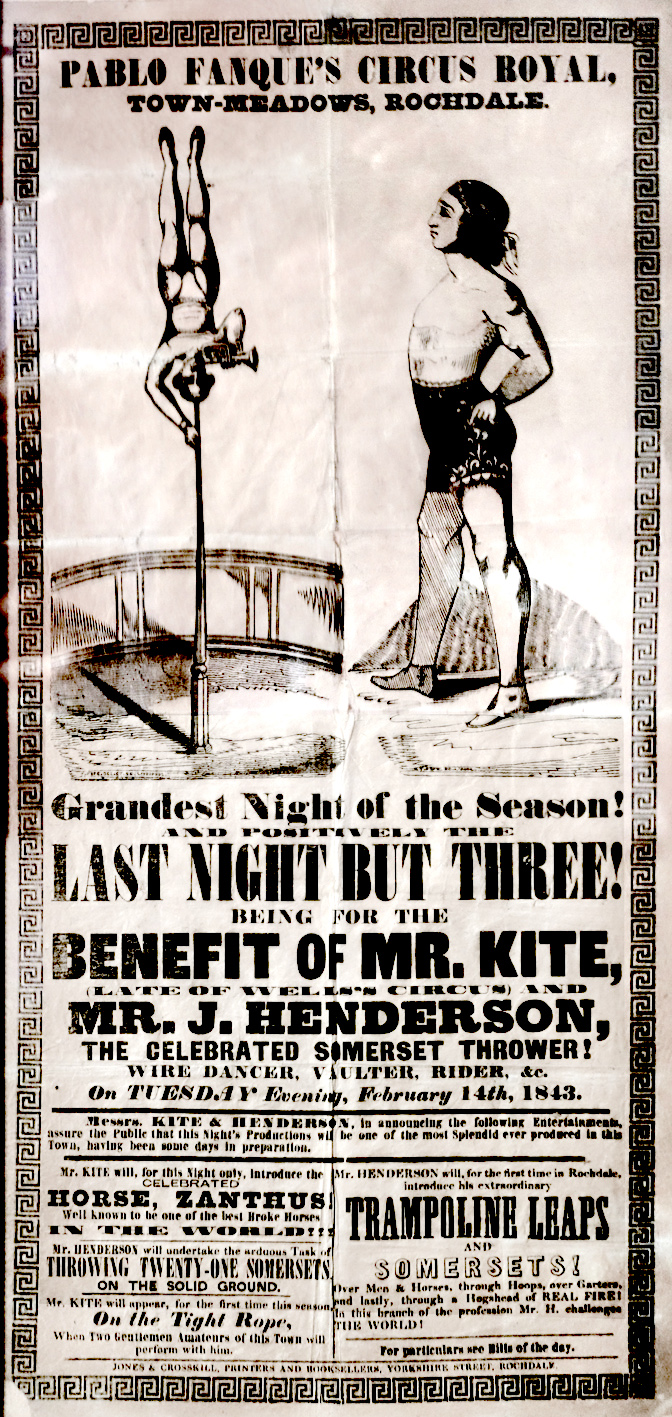
The circus poster
Pablo Fanque - 1843 Rochdale
On 31 January 1967, while filming in Sevenoaks, Lennon walked into an antique shop and bought an 1843 circus poster for Pablo Fanque's Circus Royal in Rochdale. Pablo Fanque was the first recorded Black circus owner in Britain. The poster listed Mr. Kite, the Hendersons, and a horse named Zanthus. Lennon copied the words almost verbatim: "I had all the words staring me in the face." To create the fairground atmosphere, George Martin cut organ tape into strips, threw them in the air, and had engineers splice them randomly back together.
The 1843 poster Lennon bought in a Sevenoaks antique shop. Public domain. Jones & Crosskill, Printers, Rochdale
The accidental trip
The roof - 21 March 1967
During a "Getting Better" session, Lennon reached into his silver pillbox for an amphetamine and took LSD by mistake. George Martin, unaware, noticed Lennon "swaying gently against my arm and resonating like a human tuning fork" and took him to the roof for air. Martin later: "If I'd known it was LSD, the roof would have been the last place I'd have taken him." McCartney and Harrison realised what had happened and sprinted upstairs. McCartney took Lennon home and, in solidarity, took LSD himself - the first time he had tripped alongside any bandmate.
05
The songs - what most people miss
"Picture yourself in a boat on a river"
Lucy in the Sky with Diamonds, track 3
Five songs. The details that get lost in the mythology.
01
A Day in the Life
Track 13 - the centrepiece
Two unfinished songs stitched together. Lennon's came from the Daily Mail - "he blew his mind out in a car" refers to Tara Browne, a 21-year-old heir to the Guinness fortune who died in a traffic collision in December 1966. McCartney contributed the middle section about a man who catches the bus and arrives late for work. The crescendo: 40 musicians given the lowest and highest notes on their instruments, told to get from one to the other in 24 bars however they chose. Recorded four times, all four takes stacked. The final chord: three pianos, four people, E major, take nine. Emerick pushed the faders as it decayed over 40 seconds.
02
Being for the Benefit of Mr. Kite!
Track 7 - the poster song
Almost every word from the 1843 Pablo Fanque circus poster Lennon bought in an antique shop in Sevenoaks. He changed almost nothing. The fairground sound beneath it - the swirling organ, the hurdy-gurdy atmosphere - came from Martin cutting tape into strips, scattering them on the floor, and having engineers splice them back together in whatever order they landed.
03
Within You Without You
Track 8 - Harrison alone
Harrison alone with Indian musicians from the Asian Music Circle. He sat cross-legged on the floor and recorded the entire track without the other Beatles present. The laughter you hear at the end was his idea - added deliberately to break the tension after five minutes of Indian classical structure. The rest of the band did not play on this song at all.
04
She's Leaving Home
Track 6 - the real runaway
Based on a real newspaper story about a teenage girl named Melanie Coe who left home without warning, leaving only a note for her parents. What McCartney didn't know when he wrote it: he had met Melanie Coe three years earlier. In 1963, he had picked her as the winner of a Ready Steady Go competition. She was 13 at the time. He didn't remember. She didn't make the connection until decades later.
05
Good Morning Good Morning
Track 11 - the commercial
Lennon wrote it after watching a Kellogg's Corn Flakes commercial. The animal sounds that close the song are not random. They are sequenced so that each animal could theoretically eat the one before it in the chain. The rooster at the end leads into the Reprise by matching its key. The transition was deliberate.
06
What it's really about
"We're Sgt. Pepper's Lonely Hearts Club Band, we hope you have enjoyed the show"
Sgt. Pepper's Lonely Hearts Club Band (Reprise), track 12
Three layers. Most listeners catch one. Here are all three.
Layer one
The death of the touring band
The Beatles killed themselves and resurrected as fictional characters. The wax figures of their former selves literally stand in the crowd on the cover watching their replacements perform. The album is simultaneously a funeral and a rebirth. The alter ego gave them permission to do things the Beatles could never do - to experiment, to fail, to refuse the demand for Please Please Me again.
Layer two
Studio as instrument
For the first time in pop music, the recording studio was not where songs were captured - it was the instrument used to create them. Sounds that could never exist live, built from tape manipulation, Leslie cabinets, four-track bouncing and invention. The album could only exist as a recording. There was never a plan to perform it. The studio was the point.
Layer three
The collage as form
McCartney was studying Stockhausen and Cage. The album borrows the collage form from visual art and applies it to music: Indian classical, music hall, rock and roll, orchestral, musique concrete, circus and spoken word assembled into a continuous whole. The cover is a collage. The inner groove is a collage. The album itself is a collage. The form is the message.
07
The tracklist
Thirteen tracks. The full sequence, with the detail buried in each one.
Yellow = highlighted trackPurple = lore track
#
Title
What you might not know
1
Sgt. Pepper's Lonely Hearts Club Band
Born from S&P packets on a Kenya flight. The alter ego that gave them permission to become someone else.
2
With a Little Help from My Friends
Written specifically for Ringo's vocal range. "What would you think if I sang out of tune" was a genuine question about his voice.
3
Lucy in the Sky with Diamonds
Julian's drawing of his classmate Lucy Vodden. The LSD acronym is coincidental. Lucy passed away in 2009. The original drawing belongs to David Gilmour.
4
Getting Better
The McCartney-Lennon creative dynamic in two lines. Also: the session where Lennon accidentally took LSD instead of an amphetamine.
5
Fixing a Hole
McCartney fixing the roof of his Scottish farmhouse. Not a drug reference. A song about preserving the space to think freely.
6
She's Leaving Home
Based on a real runaway, Melanie Coe. McCartney had unknowingly met her three years earlier at a TV competition he judged in 1963.
7
Being for the Benefit of Mr. Kite!
Every word from an 1843 poster. Pablo Fanque was Britain's first recorded Black circus owner. Organ tape thrown in the air and spliced at random.
8
Within You Without You
Harrison alone with Indian musicians. No other Beatle played on this track. The laughter at the end was his deliberate choice.
9
When I'm Sixty-Four
McCartney wrote the melody as a teenager. One of the oldest compositions on the album, finally finished and recorded here.
10
Lovely Rita
Named after a real traffic warden. McCartney initially mishearing the name "Meta" led to the song's concept.
11
Good Morning Good Morning
Inspired by a Corn Flakes commercial. The animals at the end are sequenced so each could theoretically eat the previous one.
12
Sgt. Pepper's (Reprise)
The only track recorded effectively live - one take, no overdubs. 57 seconds. The bow at the end of the show.
13
A Day in the Life
Two newspaper clippings. 40 musicians. Four stacked takes. Three pianos. Four players. One 40-second E major chord. A dog whistle. Then the inner groove.
Sources
The Beatles Anthology (Apple Corps, 2000). Recording the Beatles by Kevin Ryan and Brian Kehew (2006). Revolution in the Head by Ian MacDonald (1994). Beatles Bible session logs. Geoff Emerick, Here, There and Everywhere (2006).
IF YOU LIKED THIS
Read these next
Albums about alter egos, studio invention, and the moment pop music decided it could be anything.