Ziggy Stardust David Bowie
David Bowie created a fictional rock star, became him so completely he couldn't separate the character from himself, then killed him onstage at the Hammersmith Odeon in a farewell announcement that blindsided his own band.
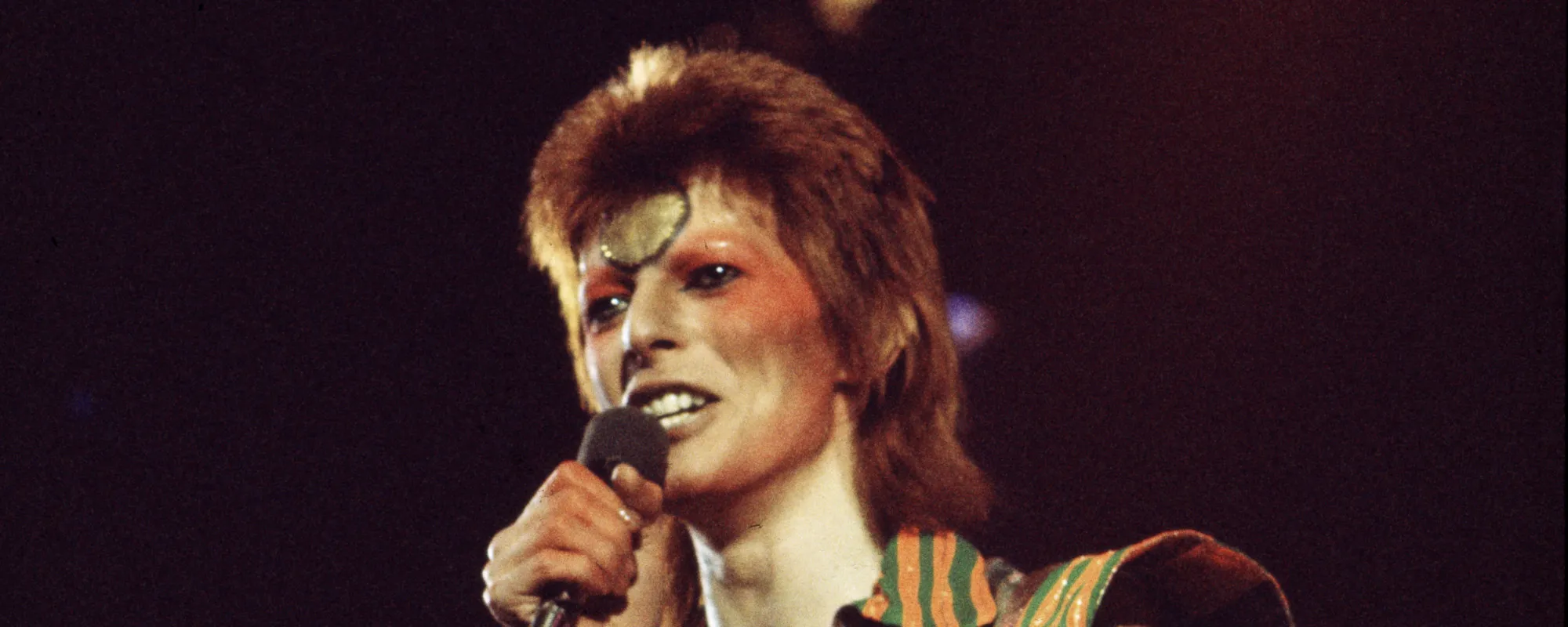
The origin story
Bowie was a failed pop singer with one genuine hit when he conceived Ziggy. "Space Oddity" had made him recognisable but not important. The Man Who Sold the World and Hunky Dory had earned him critical respect but almost no sales. He was nearly twenty-five years old, admired by musicians, ignored by the public, and acutely aware that time was running out. He needed not just a better album but a better self.
The character that emerged was composite. He borrowed Iggy Pop's raw physical abandon, the stage danger that made you believe something might actually go wrong. He borrowed from Vince Taylor, a British rocker who'd become a cult figure in 1960s Paris by telling his fans he was a god and an alien, then had a very public nervous breakdown trying to prove it. He borrowed the surname from the Legendary Stardust Cowboy, a Texas novelty act whose outsider energy appealed to Bowie precisely because it had no obvious audience. Ziggy was a patchwork messiah sewn together from other people's madness.
The album was recorded across November 1971 through February 1972 at Trident Studios in London, co-produced with Ken Scott. The backing band would become the Spiders from Mars: Mick Ronson on guitar, Trevor Bolder on bass, Mick Woodmansey on drums. Ronson was particularly essential. His guitar playing gave Ziggy the physical voltage the character required. Without Ronson, the album has glitter. With him, it has electricity.
The character
Ziggy is a fictional androgynous bisexual rock star sent to Earth as a saviour before an apocalypse. The world has five years left. He arrives with a message of hope, seduces everyone, is consumed by his own ego, and is destroyed by the fame he created. The album is his rise and fall told in thirty-eight minutes, beginning with the countdown and ending with a man reaching up for his rescuers from the gutter.
Bowie didn't just write about Ziggy. He became him. The red hair was dyed for the character. The kabuki-influenced makeup was painted on every morning. The platform boots added inches he didn't have. The jumpsuits were made by Japanese designer Kansai Yamamoto, who had never heard of Bowie but whose work happened to look exactly like what an alien rock star from a Kubrick film might wear. Every public appearance was an in-character performance. The line between David Jones from Brixton and Ziggy Stardust from Mars dissolved so completely that Bowie later said he genuinely couldn't remember which one he was.
He has spoken carefully about what this did to him. The character was liberating and then it was terrifying. He was able to do things as Ziggy that David couldn't do, say things that David couldn't say, be things that David wasn't allowed to be. But the character eventually had to be killed because Bowie was no longer certain he could kill it.
The lore layer
The songs
Five songs. Not the obvious readings. The things underneath.
What it's really about
Ziggy Stardust operates on three thematic levels simultaneously. The glitter is on the surface. The meaning is underneath.
The tracklist
Eleven tracks. Thirty-eight minutes. The complete rise and fall, in sequence, as Bowie intended.
Read these next
Albums about invented personas, fame as performance, and the line between the artist and the mask.