8 TracksNo Title. No Band Name.37 Million Copies Sold1 Drum Kit in a Stairwell
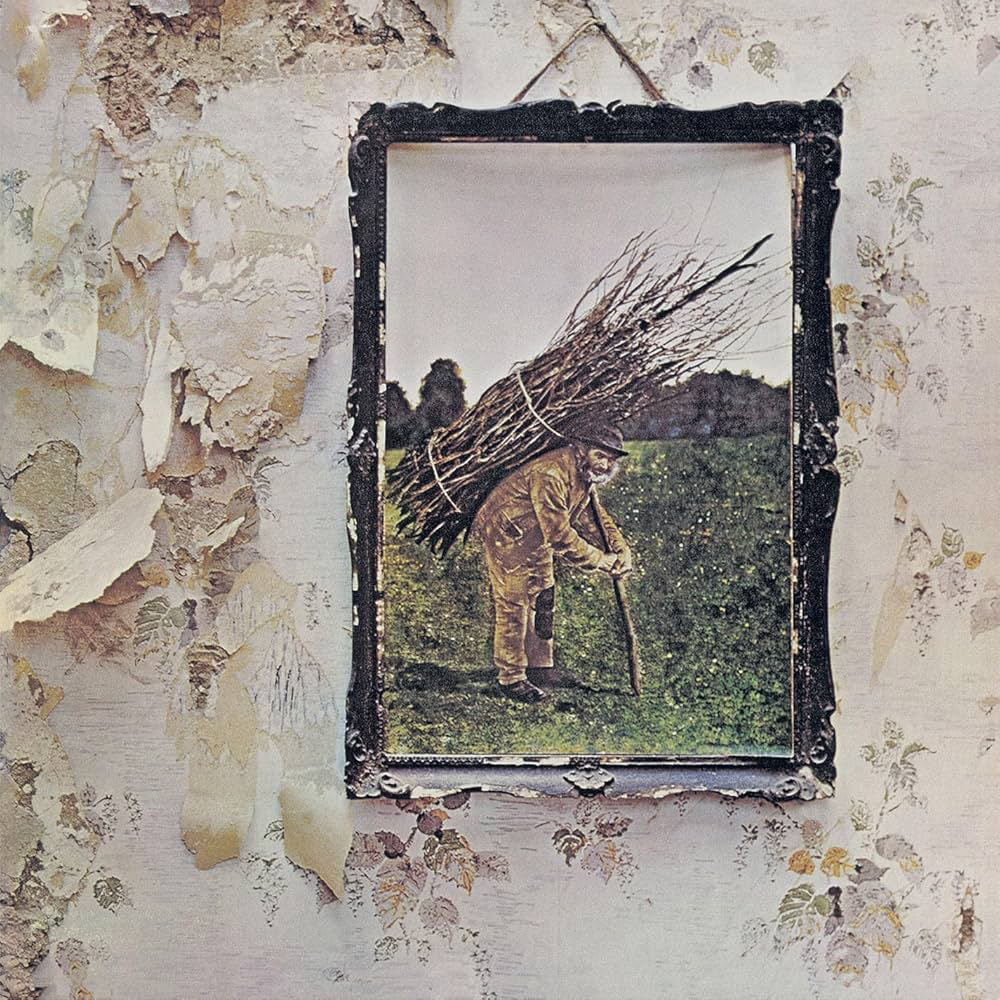
After Led Zeppelin III drew lukewarm reviews, Jimmy Page decided the band's reply would be an album that carried no title, no band name and nothing on the sleeve to identify it. Atlantic Records warned that this was commercial suicide. The band went ahead anyway. The record became the best seller of their career and one of the most pored-over in rock.
"An untitled album struck me as the best answer to all the critics, because we knew the way the music was being received, both in sales and in the size of the crowds at the concerts."
Jimmy Page, on the 2014 reissue of Led Zeppelin IV
01
The origin story
"There walks a lady we all know"
Stairway to Heaven, track 4
Led Zeppelin III arrived in October 1970 to reviews that frustrated the band. Critics found it inconsistent, too acoustic, short on the heavy rock the first two albums had established. Sales held up, but the press was dismissive. Page took the lesson to heart. The critics kept measuring each new album against the last one, sorting it and filing it, so he set out to take the reference points away. The fourth record would carry no name and no title, only the music and a set of symbols that meant nothing to anyone who had not gone looking. The audience could find the album on its own terms rather than have it framed for them in advance.
Atlantic Records objected. A record with no band name on the cover was, the label said, commercial suicide, and it had reasons to worry, since shops stocked albums by artist name and an unidentified sleeve was harder to sell. The label pushed hard, and the band did not give way. The album came out on 8 November 1971 with no title, no band name and no text of any kind on the outer sleeve, not even a catalogue number. Robert Plant had found the cover image, a 19th-century oil painting of an old man carrying a bundle of sticks, in an antique shop in Reading. The back cover showed a demolished tower block in Dudley. Plant said the contrast was deliberate, the old world set against the new, the country against the industrial, one giving way to the other. Nobody was told what any of it meant.
Naming the album has been a small problem ever since. Most people call it Led Zeppelin IV, following the numbered run of the first three. Atlantic has also used Four Symbols and The Fourth Album. Some call it ZoSo, after Page's symbol, and some call it the Runes album. The band has never settled on an official title. Whatever you call it, it has sold 37 million copies, which makes the suicide diagnosis look generous.
October 1970
Led Zeppelin III and the critical backlash
The third album lands to lukewarm reviews, and critics call it inconsistent. Page decides the fourth will give them nothing to categorise: no title, no band name, no reference points.
December 1970
Headley Grange sessions begin
The band moves into Headley Grange, a former Victorian workhouse in Hampshire, with the Rolling Stones Mobile Studio parked outside. Page had worked there before and liked the isolation and the sound of the building. They live on site, and most of the material grows out of informal jams rather than finished songs.
December 1970
When the Levee Breaks, the stairwell night
Engineer Andy Johns sends the rest of the band to the pub and keeps Bonham back. He sets the drum kit at the foot of the three-storey stairwell and hangs two microphones at the top. The natural reverb of the hall does what no studio could, and Bonham is delighted with the playback.
Early 1971
Completion and the Atlantic confrontation
Sessions carry on at Island Studios in London, and the album is mixed at Sunset Sound in Los Angeles. Only the Sunset Sound mix of When the Levee Breaks survives to the final record; the rest are remixed at Olympic Studios in London. Atlantic receives a finished album with nothing on the sleeve to identify it and objects. The band declines to add anything.
8 November 1971
Released with no name
The album ships with no text on the outer sleeve, not even a catalogue number. The inner sleeve carries the four symbols and a painting of the Hermit from the tarot. It reaches number one in the UK and number two in the US, sells in huge numbers, and this time the reviews are far warmer. The gamble pays off.
02
The production
"If there's a bustle in your hedgerow, don't be alarmed now"
Stairway to Heaven, track 4
The Rolling Stones Mobile Studio, a recording rig built into a truck that the Stones had put together for their own albums, sat outside Headley Grange throughout the sessions. Working from the truck rather than a commercial studio gave Page full control of the room and the schedule. There was no booking clock to fight. If something was not working they stopped, and if it was working they kept going. Page later called Headley Grange a wonderful and imposing old workhouse, valuing both the isolation and the character of the building. Fleetwood Mac had rehearsed there before Zeppelin arrived, so Page already knew there would be no complaints about the noise.
A good deal of the album came out of loose jams that turned into songs. Rock and Roll started when Bonham began playing the intro to Little Richard's Keep A Knockin' during a break, and within about forty minutes it had become a finished track. Ian Stewart, the Rolling Stones pianist who had founded the band and then been left off its official line-up, was at Headley Grange during the sessions and played piano on it. Black Dog grew from a John Paul Jones riff in an unusual metre, five beats in one bar and three in the next, with Plant's vocal written so that it would not fall on the beat. The friction between the two parts is intentional, and it took real effort to play cleanly.
Page produced the album, as he had every Zeppelin record before it. He preferred to capture the sound of the room rather than place microphones tight against the instruments, and that approach runs through the whole album, heard most famously in the drums on When the Levee Breaks. Andy Johns engineered the sessions; he was the younger brother of Glyn Johns, who had engineered the debut. By every account it was the smoothest stretch of work the band had had since that first album, with nobody fighting the material.
Location
Headley Grange, Hampshire
A former Victorian workhouse the band rented for the sessions, with the Rolling Stones Mobile Studio parked outside. Page chose it for the isolation and the natural acoustics, and the band lived there while they worked. The informality produced tracks that a conventional studio booking could not have.
Rolling Stones Mobile
The stairwell
Two Mics, Three Storeys
Andy Johns hung two Beyerdynamic M160 ribbon microphones at the top of the three-storey stairwell, with Bonham's kit at the bottom and no other drum mics in use. The signal ran through a Helios console and a Binson Echorec, and the whole track was later slowed down slightly to lower the pitch. The result became one of the most sampled drum sounds in music.
When the Levee Breaks
The accident
Rock and Roll
Bonham launched into the intro to Little Richard's Keep A Knockin' during a break, the others joined in, and roughly forty minutes later it was finished. Ian Stewart, the founding Rolling Stone left off the band's official line-up, happened to be there and played piano on it. One of the fastest complete recordings Zeppelin ever made.
40 minutes start to finish
Guest vocalist
Sandy Denny
Denny, the singer with Fairport Convention and one of the finest voices in British folk, sang on The Battle of Evermore, the only guest vocalist ever to appear on a Led Zeppelin studio album. She was also the only musician on the record not given one of the four symbols, and she was simply credited by name. She died in 1978, aged thirty-one.
Zeppelin's only guest vocalist
03
The symbols
"What's your symbol mean, Jimmy?" "I eat bananas."
Page, answering a question during a television appearance
The inner sleeve carries four symbols, one for each member. Page said they came from a standard reference book of occult signs, the kind believed in esoteric traditions to hold a particular meaning or power, and each man chose his own. The identities are known. The meanings, for the most part, are not, and the band has guarded the ambiguity with varying commitment over the years. Asked on television what his symbol meant, Page answered, "I eat bananas." Plant once recalled that Page took him aside, explained the meaning of his symbol a single time, and never raised it again. What he said has never been recorded.
Jimmy Page, guitarist
ZoSo: the undisclosed
The most discussed and least explained of the four. The reading ZoSo comes from how the symbol looks rather than from anything Page has confirmed, and he designed it himself. It may relate to a 16th-century alchemical text by Gerolamo Cardano, where a similar glyph stands for Saturn. Page's long interest in Aleister Crowley, whose former house, Boleskine on Loch Ness, he owned, gives some background to the choice without explaining it. He has never confirmed the meaning, and he may never do so. The mystery is almost certainly the point.
Robert Plant, vocalist
Feather in a circle: Ma'at's emblem
Plant's symbol is a feather inside a circle, the feather of Ma'at, the Egyptian goddess of truth, justice and balance. In the myth the heart of the dead was weighed against her feather, and a lighter heart passed on. Plant traced the design to The Sacred Symbols of Mu, a 1933 book by Colonel James Churchward. The feather also stands for a writer, which suited the band's main lyricist.
John Paul Jones, bassist and keyboardist
Interlocking circles: confidence and competence
Jones's symbol is a single intersecting circle, a form of triquetra, taken from Rudolf Koch's Book of Signs of 1933. Koch describes it as a sign of someone who has both confidence and competence, which fitted the most musically trained member of the band and the only one with a professional session career before it formed. He chose it without ceremony, and it remains the least discussed of the four.
John Bonham, drummer
Three interlocking rings: and Ballantine beer
Bonham's symbol, three interlocking rings, also comes from Koch's Book of Signs, where it stands for the trinity of mother, father and child. Bonham picked it partly for that family meaning. On a tour stop in Pittsburgh the band noticed that the same three rings were the logo of Ballantine beer, which Bonham happened to like. As Plant put it, "Bonzo just liked it." The solemn explanation and the cheerful one have always sat side by side.
The inner sleeve also shows a painting of the Hermit, a robed figure holding up a lantern on a mountaintop, by Barrington Colby. The mountain behind him was filmed on the hillside above Boleskine House, Page's Scottish property and once Crowley's. The Hermit is the ninth card of the tarot's Major Arcana. No reason was ever given for putting it there.
04
The lore layer
"It was totally alien to me"
Jimmy Page, testifying about Spirit's Taurus, Los Angeles, 2016
The plagiarism case
Stairway to Heaven and Spirit's Taurus: six years in court
Spirit, a psychedelic rock band from Los Angeles, recorded an instrumental called Taurus in 1968, and its opening section uses a descending chromatic guitar figure. Led Zeppelin opened for Spirit on their first US tour in 1968 and 1969. Spirit's guitarist, who went by the stage name Randy California, pointed out the resemblance in the sleeve notes of a 1996 reissue. He drowned in 1997 without ever taking legal action. His estate did so in 2014, through the trustee Michael Skidmore, arguing that the shared billing had given Zeppelin access to the song and that its descending figure had found its way into the introduction of Stairway to Heaven. The case reached court in Los Angeles in May 2016. Page testified that he had never heard Taurus, calling it totally alien to him, and the jury cleared the band, finding the two pieces not similar enough. The estate appealed. In 2018 a three-judge panel of the 9th Circuit set the verdict aside and ordered a new trial on procedural grounds, but Led Zeppelin won a rehearing before the full court. In March 2020 an eleven-judge panel of the 9th Circuit reinstated the original jury verdict, so no retrial ever took place, and the Supreme Court declined to take the case later that year. Led Zeppelin were cleared. The descending figure, which turns up in hundreds of folk and classical pieces written long before either song, was held not to be protected here.
The most sampled beat
When the Levee Breaks, and the artists who took it
The two bars of drums that open When the Levee Breaks, Bonham at the foot of the stairwell caught by two microphones at the top, became one of the most sampled breaks in recorded music. The Beastie Boys used it on Rhymin and Stealin, Eminem on Kim, Bjork on Army of Me and Massive Attack on Angel, and many others have built tracks on it. The song itself is a cover, written by Kansas Joe McCoy and Memphis Minnie in 1929 about the Great Mississippi Flood of 1927. The album credits Memphis Minnie alongside the four members of the band.
The cover painting
Robert Plant found it in a Reading antique shop
The front cover is a 19th-century oil painting of an old man carrying a bundle of sticks, which Plant bought in an antique shop in Reading. The painter is unknown. The back cover shows a tower block in Eves Hill, Dudley, part of Plant's home patch in the West Midlands, with one building being pulled down beside the old man and his load. Plant described it as the old giving way to the new. Nothing was printed on the gatefold.
The Black Dog meter
John Paul Jones wrote a riff built to trip up the singer
John Paul Jones wrote the main riff of Black Dog in an awkward time signature, the bars shifting between five beats and three so that the pattern never resolves where you expect it. He and Page then wrote Plant's vocal to sit off the riff's downbeats, so the voice and the riff share the same harmony while landing in different places. When the band rehearsed it, Plant struggled to come in at the right moment, and you can hear that tension in the finished take, the voice always seeming a little early or late and somehow right. The song is named after a Labrador that wandered into Headley Grange during recording and would not leave.
05
The songs, in detail
"Oh it makes me wonder"
Stairway to Heaven, track 4
Five of the eight tracks, and the things that tend to get lost behind the mythology.
01
Black Dog
Track 1: the riff and where it lands
Named after a Labrador that wandered into Headley Grange and stayed. The main riff moves between five-beat and three-beat bars, a pattern Jones built to be hard to come in on, and Plant's vocal was written to avoid the downbeats, which keeps the whole thing on edge. You can hear Plant fighting the metre and just winning on each entry. The title has nothing to do with the symbols or the occult corners of the album. A stray dog turned up, and they named a song after it.
02
Stairway to Heaven
Track 4: the one that became a problem
Page wrote the chord sequence at Headley Grange in a single evening, and Plant, sitting across the room, wrote the opening lyrics almost as quickly, later saying the words seemed to arrive on their own. It was never released as a single, which was unusual for what became one of the most requested songs in the history of FM radio. Page has called it the track where everything the band could do came together, from acoustic to electric and from quiet to full force, in one long arc. The plagiarism case over Spirit's Taurus ran for six years, through a jury trial and a string of appeals, and ended in the band's favour. The descending figure at the start predates both Spirit and Led Zeppelin by centuries.
03
The Battle of Evermore
Track 3: Tolkien, and the one guest
Plant wrote the words after an evening reading about the Battle of the Pelennor Fields in The Lord of the Rings. Page had been playing a mandolin belonging to Jones and came up with the chords that same night. The medieval imagery and the sound of the mandolin called for a second voice answering Plant's lead, and Sandy Denny of Fairport Convention was brought in to sing it. She is the only guest vocalist on a Led Zeppelin studio album. She died in 1978 after a fall, aged thirty-one.
04
Going to California
Track 7: the quiet one
A gentle acoustic song Plant wrote about how much Joni Mitchell's music meant to him, framed as a search for her in California that never quite finds her. Jones plays mandolin and Page the guitars. It is the softest thing on any Led Zeppelin album, and it sits between Four Sticks and When the Levee Breaks, the calm before the loudest ending. It is easy to treat it as a pause on the way to the closer, but the placement is a choice, not an afterthought.
05
When the Levee Breaks
Track 8: the closer, and the most sampled beat in music
A 1929 recording by Memphis Minnie and Kansas Joe McCoy about the Great Mississippi Flood of 1927, which Zeppelin rebuilt completely and on which Memphis Minnie shares the credit. The drum sound, Bonham at the foot of the three-storey stairwell with two Beyerdynamic M160 ribbon microphones at the top and nothing else on the kit, is among the most copied in record production. The tempo sits around seventy beats a minute, slow for rock and closer to a ballad, and the mix of that slowness, the size of the room and Bonham's weight makes the track sound enormous. The band played it live only a handful of times. They knew the studio version was the one.
06
The aftermath
"No Stairway? Denied."
The guitar-shop joke in Wayne's World, 1992, by which point the song had been heard so often that playing it had become a punchline
Act one
Stairway becomes a phenomenon
The song was never a single and still became one of the most requested records in the history of FM radio. By the middle of the 1970s some American stations had played it so often that they brought in no Stairway policies. The guitar-shop scene in Wayne's World, with its no Stairway to Heaven sign, was not invented for the film; it reflected the fact that the song had been heard so many times that playing it in public had become a cliche. There is a neat irony in that. Page and Plant wrote a song about a woman looking for something she cannot reach, and the song grew so familiar that it became hard to hear at all.
Page regards Stairway to Heaven as the track where everything the band could do came together. Plant's relationship with it has been more uneasy; he has spoken about tiring of it and has at times refused to sing it. In 2007, at the O2 Arena reunion, with Bonham's son Jason on drums, he sang it, and the concert is often counted among the band's best. The reunion set a Guinness World Record for ticket demand, with around twenty million requests for some twenty thousand places.
Act two
John Bonham, 25 September 1980
John Bonham died on 25 September 1980, aged thirty-two, at Page's house near Windsor. He had drunk a great deal of vodka over the course of the day and died in his sleep, the cause given as asphyxiation. That December the band issued a short statement: "We wish it to be known that the loss of our dear friend, and the deep sense of undivided harmony felt by ourselves and our manager, have led us to decide that we could not continue as we were." They had been together for twelve years, and they never performed again as Led Zeppelin.
Bonham had been the foundation of everything on this album and the records before it. The drum sound on When the Levee Breaks can be reproduced in theory, the stairwell, the microphones, the Echorec, but not in practice, because the same kit in the same hall does not sound the same without Bonham playing it. It is sampled so widely for that very reason: it cannot simply be played again.
Act three
The legacy
Led Zeppelin IV has sold more than 37 million copies and sits near the top of most lists of the greatest albums. Rolling Stone placed it at number 58 in the 2020 edition of its 500 Greatest Albums. It is the band's best seller, their commercial peak reached without a single commercial concession, which was the whole point of Page's stand when he made Atlantic release it with no name.
Its influence is too broad to trace through any one line. The drums on When the Levee Breaks became a building block of hip-hop production and changed the way the genre sounded. Stairway to Heaven set a template for the quiet-to-loud rock ballad that countless bands went on to follow. The four symbols are among the most recognisable personal marks in popular music, and Page's ZoSo appears on more merchandise and more tattoos than any other piece of Zeppelin imagery. He still has not said what it means.
07
What it adds up to
"And as we wind on down the road"
Stairway to Heaven, track 4
The album works on more than one level at once, and most accounts settle for just one of them.
Layer one
Anonymity as argument
Releasing the album without a name was more than a provocation; it was a position. The music should stand on its own, apart from the brand. The press had been judging each record against the last, so taking the name off took the expectation away with it. The listener arrives without a frame, and the music supplies its own. It worked in the shops, and it worked as an idea, since the album is still talked about as a thing in itself rather than as the fourth Zeppelin record in a way the earlier albums are not.
Layer two
Old world / new world
The cover painting and the Dudley tower block set out the album's visual idea: the old against the new, the country against the city, the handmade against the industrial. The same pull runs through the music. The Battle of Evermore is medieval, all mandolin and folk melody and Tolkien. Rock and Roll began as a Little Richard cover thrown up by a stray drum pattern. When the Levee Breaks is a 1929 blues recorded with 1970s equipment in a Victorian stairwell. The album moves between centuries as though the gap were smaller than it looks.
Layer three
The hidden and the revealed
The interest in the occult runs through all of it: the symbols, the unexplained ZoSo, the Hermit on the inner sleeve, the Boleskine hillside behind the painting, Page's Crowley collection. The album sets up a world where meaning is present but withheld, where the symbols carry a weight that is never spelled out. That is what Stairway to Heaven does in miniature, the soft opening hiding the storm that follows. The packaging and the song make the same case: what you can see is not all that is there.
08
The tracklist
Eight tracks, around forty-three minutes, no title and no band name, and 37 million copies sold.
Gold = featured song (section 05)Green = significant lore
#
Title
What you might not know
1
Black Dog
Named after a Labrador that wandered into Headley Grange and refused to leave. The riff moves between five-beat and three-beat bars, and Plant's vocal was written to avoid the downbeats. The difficulty is audible, and it is meant to be.
2
Rock and Roll
Started when Bonham played the intro to Little Richard's Keep A Knockin' during a break, and was finished in roughly forty minutes. Ian Stewart, a founding Rolling Stone left off the band's official line-up, was at Headley Grange and played the piano part.
3
The Battle of Evermore
The words came from Plant reading about Tolkien's Battle of the Pelennor Fields the night before. Sandy Denny of Fairport Convention sang the answering vocal, the only guest singer on a Led Zeppelin studio album. She died in 1978, aged thirty-one.
4
Stairway to Heaven
Never released as a single, and still the most requested track in FM radio history. Page wrote the chords in one evening at Headley Grange and Plant wrote the opening lines at the same time, saying they arrived fully formed. The six-year case over Spirit's Taurus ended in the band's favour in 2020.
5
Misty Mountain Hop
John Paul Jones opens on electric piano. The title nods to Tolkien's Misty Mountains, while Plant's lyric describes a run-in between police and a crowd in a London park. The fantasy reference and the real scene sit together without comment, which is a fair summary of how Plant wrote throughout.
6
Four Sticks
Named for Bonham playing it with four sticks rather than two. The shifting time signature, between 5/8 and 6/8, gave the band so much trouble that they set the song aside and came back to it later. One of the most rhythmically awkward things they recorded.
7
Going to California
Plant wrote it about his admiration for Joni Mitchell and a search for her in California that comes up empty. Entirely acoustic, with Jones on mandolin. The quietest moment on any Led Zeppelin album, placed between Four Sticks and When the Levee Breaks as the calm before the loudest ending.
8
When the Levee Breaks
Written by Memphis Minnie and Kansas Joe McCoy in 1929 about the Great Mississippi Flood of 1927, with Memphis Minnie sharing the credit. The drums were recorded with Bonham at the foot of a three-storey stairwell and two Beyerdynamic M160 microphones at the top, heavily compressed, run through a Binson Echorec and slowed down. One of the most sampled breaks in music. Zeppelin played it live only a few times.
Sources
Jimmy Page, Led Zeppelin IV Super Deluxe Edition liner notes (2014). Wikipedia, Led Zeppelin IV. Wikipedia, Stairway to Heaven (song). Wikipedia, When the Levee Breaks. Wikipedia, Led Zeppelin IV symbols. Rudolf Koch, Book of Signs (1933). James Churchward, The Sacred Symbols of Mu (1933). Andy Johns, MusicRadar interview (2009). Vintage King Audio, "Recreating the Drum Sounds of When the Levee Breaks" (2018). Dark Horse Institute, "When the Levee Breaks: Stairwell Drum Sounds." RadioX, "How Led Zeppelin won the Stairway to Heaven plagiarism case" (2020). NBC News, "Led Zeppelin prevails in Stairway to Heaven copyright dispute" (2020). Skidmore v. Led Zeppelin, 9th Circuit en banc opinion (March 2020). Rolling Stone, "500 Greatest Albums of All Time" (2020 revision). ThisDayInMusic, "Led Zeppelin IV." Robert Plant, interviews on the cover painting and the Dudley back cover. Stephen Davis, Hammer of the Gods (1985).
IF YOU LIKED THIS
Read these next
Albums that turned down the obvious commercial move and made a virtue of what they held back.