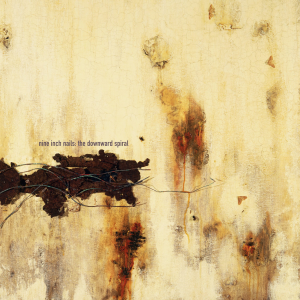
1994 · Nothing / Interscope Records · 2nd Studio Album
14 Tracks18 Months in a Murder House1 Door Taken4M Copies Sold
The album maps a man's destruction track by track. Faith gone, body gone, will gone, self gone. Trent Reznor made it alone, in the house where Sharon Tate was murdered, in a studio he named Le Pig after the word written in her blood on the front door.
"The house didn't feel terrifying so much as sad. Peacefully sad. But that could just be my own insanity."
Trent Reznor, Entertainment Weekly, 1994
01
The origin story
"I am the voice inside your head"
Mr. Self Destruct, track 1
Pretty Hate Machine had made Nine Inch Nails famous. That was the problem. Trent Reznor had spent years building a record in private, alone in a Cleveland recording studio at night after his day job, assembling something obsessive and precise on a limited budget. Then it sold a million copies and he had to tour it for two years, playing arenas and festivals, performing for audiences who wanted the songs to be bigger than they were. The isolation that had made the music stopped being possible.
What he came back with was the Broken EP in 1992 - harder, angrier, less architecture and more wreckage. And then he started thinking about what would come next. He had been reading David Bowie's Low and listening to Pink Floyd's The Wall compulsively. Both were concept albums about a man retreating from the world - Bowie's via experimental ambience, Floyd's via a protagonist who builds walls between himself and everyone else until he is entirely alone. Reznor wanted to take that template further. Not a man retreating. A man dismantling. Every track on the album would represent another piece of the protagonist removed or destroyed - his faith, his body, his relationships, his sense of self, his will to live. By the end, there would be nothing left.
The album needed a location. He was looking for somewhere in Los Angeles to set up a studio. He viewed fifteen properties in a day. The one he liked best sat up in Benedict Canyon, overlooking Beverly Hills, with ocean on one side and downtown on the other. A cool, tranquil ranch house with a nice yard. And it was cheaper than the others. A friend had dinner with him shortly after and asked about the address. Cielo Drive. The friend went pale. He had a copy of Helter Skelter at home - the definitive account of the Manson murders. He brought it over. Reznor compared the photographs in the book with what was around him. The same bedroom. The same front door. The same pool.
He did not move out. He named the studio Le Pig, after the word "Pig" that Susan Atkins had written in Sharon Tate's blood on the front door of the house in August 1969. He recorded there for eighteen months. The concept album about self-destruction was made in a place where the actual destruction of actual people had occurred twenty-five years earlier. Whether that was genius or tastelessness is a question the album never resolves, because Reznor himself could not resolve it.
1989-1991
Pretty Hate Machine and the road
NIN's debut sells over a million copies. Reznor tours relentlessly. The isolation that made the record possible becomes impossible to maintain. He watches himself becoming something he did not intend. The excess, the road, the money, the loss of control. All of it goes into the next record.
1992
Broken EP and the move to Los Angeles
Reznor releases Broken, an angrier, harder EP recorded partly at Trent's new home studio setup. He moves to Los Angeles looking for a space to record a full album. He views fifteen houses. He rents the one at 10050 Cielo Drive in Benedict Canyon - the cheapest, the most secluded, the most interesting.
1992
Discovery - Le Pig
A friend identifies the address from Helter Skelter - the definitive Manson murders account. Reznor confirms it with photographs. He names the studio Le Pig, after the message written in blood on the front door. He calls his first night there "terrifying." He stays anyway. Recording begins.
1992-1993
Eighteen months of recording
Reznor and co-producer Flood build The Downward Spiral track by track at Le Pig. Marilyn Manson also records sections of Portrait of an American Family at the studio during this period. Reznor's own mental health deteriorates alongside the album's protagonist's. The record is increasingly autobiographical even as it is presented as fiction.
December 1993
Reznor leaves - taking the door
He moves out. "There was too much history in that house for me to handle." He takes the front door with him - the door with Tate's blood sealed beneath layers of paint - and installs it at his new studio in New Orleans, a former funeral home, where he will eventually record The Fragile. The house at Cielo Drive is demolished in 1994. The door is all that remains.
March 8, 1994
The Downward Spiral released
Nothing Records and Interscope release the album. It sells four million copies. It receives near-universal critical acclaim - the exception being, Reznor noted bitterly, the Cleveland press. The Self Destruct tour begins. Everything gets louder and more violent before it gets quieter.
02
The production
"I want to fuck you like an animal"
Closer, track 3
The key equipment was a large mixing console and two Studer multitrack tape machines, bought outright because Reznor calculated it was cheaper than renting studio time. A Macintosh computer ran alongside them for sound manipulation and editing. Synthesizers included the Minimoog and Prophet VS. Drum machines included the Roland TR-808. The approach was to use all of it to build texture rather than song - to focus on space and atmosphere, avoiding what Reznor called "explicit guitar or synthesizer use" in favour of something harder to identify and harder to escape.
Flood - Mark Ellis - had produced Pretty Hate Machine and Broken. He came back for The Downward Spiral and it would be his last collaboration with NIN. Creative differences accumulated throughout the sessions. There was a track called "Just Do It" that Flood said Reznor had "gone too far" with - he called it "very dangerously self-destructive." It was cut from the album. Flood was not wrong, and the fact that the track exists somewhere is both troubling and interesting. Their collaboration produced something definitive. It also burned the bridge.
Adrian Belew played guitar - the progressive rock guitarist whose resume included Bowie's Stage tour, Talking Heads, and King Crimson. His contribution to the album is significant but deliberately hard to hear, his guitar often processed beyond recognition into texture. Chris Vrenna handled sampling and sound design alongside the session. Stephen Perkins, drummer for Jane's Addiction, contributed to several tracks. The credits on the album reflect the collaborative nature of the recording but the creative centre was always Reznor, alone at the console in Le Pig, building a record that was becoming increasingly difficult to distinguish from autobiography.
One production fact that sits quietly in the album's liner notes and gets consistently overlooked: "Hurt" was the last song written for the album, recorded as an afterthought at A&M Studios alongside "Big Man With A Gun" when the Le Pig sessions were done. The track that became the album's emotional centre and its most enduring legacy was not part of the original vision. It was added at the end, almost incidentally. Reznor wrote it in a bedroom "as a way of staying sane, about a bleak and desperate place I was in, totally isolated and alone."
Studio
Le Pig, 10050 Cielo Drive
A ranch house in Benedict Canyon, Los Angeles. Former site of the Tate murders. Two Studer multitrack tape machines, a large mixing console, a Macintosh computer. Reznor bought the equipment outright. The whole setup was cheaper than renting a studio. He worked there for eighteen months.
Primary location
Co-producer
Flood (Mark Ellis)
Previously worked with NIN on Pretty Hate Machine and Broken. Also produced U2's Achtung Baby and Depeche Mode's Violator. His last NIN collaboration due to creative differences. He told Reznor a track called "Just Do It" had "gone too far." He was right. The track was cut.
Final collaboration
Iggy Pop sample
Closer's Percussion
The driving, piston-like percussion that defines "Closer" is a sample of Iggy Pop's "Night Clubbing" from The Idiot (1977) - the Berlin-era album Pop made with David Bowie. The same period of Bowie's work that inspired the entire album. The sample is processed beyond easy recognition but it is there.
Hidden source
Last track written
Hurt
Written after the Le Pig sessions ended. Recorded at A&M Studios as an afterthought alongside "Big Man With A Gun." Reznor wrote it in a bedroom "as a way of staying sane." The album's emotional centre and most enduring legacy was almost not included. It was added at the end and nearly left off entirely.
Afterthought
03
The house
"I went home and cried that night."
Trent Reznor, Rolling Stone, 1997
On the night of August 9, 1969, members of the Manson Family entered the property at 10050 Cielo Drive in Benedict Canyon and murdered five people. Sharon Tate, who was eight months pregnant, was stabbed sixteen times. Jay Sebring, Abigail Folger, Wojciech Frykowski, and Steven Parent were also killed. Susan Atkins wrote the word "Pig" in Tate's blood on the front door. Charles Manson himself was not present. He had been to the house before, when it was rented by music producer Terry Melcher, who had considered signing Manson as an artist and ultimately declined.
The killings ended the 1960s in Los Angeles. Joan Didion wrote in The White Album: "Many people I know in Los Angeles believe that the Sixties ended abruptly on August 9, 1969, ended at the exact moment when word of the murders on Cielo Drive traveled like brushfire through the community." The house's owner, Rudolph Altobelli, moved in three weeks after the murders and lived there until 1988. He said he felt "safe, secure, loved, and beauty" in the house. It changed hands once more before Reznor rented it in 1992.
Reznor's account of finding out differs slightly in different tellings. In one version, a friend identified the address immediately. In another, he got the Helter Skelter book to verify it after a dinner conversation. What is consistent across all versions: nobody told him when he rented it. The realtor did not mention it. The price - cheaper than comparable properties - should have been a signal. "That's always a clue," he said later. The first night was terrifying. After that it was just home.
He named the studio Le Pig. The name is where the ethics get complicated. It is a reference to what was written in a dead woman's blood on the door he was now walking through every day. He called it a "provocative joke about being in that house." At the time this seemed like the kind of dark irony that industrial rock aesthetics invited. Then he met Sharon Tate's sister.
Patti Tate. The encounter was brief and unplanned. She asked him: "Are you exploiting my sister's death by living in her house?" He said no, that it was just his interest in American folklore. She left. He went home and cried. In the 1997 Rolling Stone interview where he recounted this, he said: "I realized for the first time, 'What if it was my sister?' I thought, 'Fuck Charlie Manson.' I don't want to be looked at as a guy who supports serial-killer bullshit." The sentiment was sincere. The studio name was still Le Pig. He moved out in December 1993, citing "too much history."
He took the front door with him. The door with Tate's blood sealed beneath decades of paint - he removed it from the frame and transported it to his new studio in New Orleans, a former funeral home, where he would record The Fragile in 1999. The house at Cielo Drive was demolished in 1994. A new mansion was built on the site. The address was changed to 10066 Cielo Drive. The owner told Architectural Digest: "We went to great pains to get rid of everything. There's no house, no dirt, no blade of grass remotely connected to Sharon Tate." There is one pine tree that survived. And the door, which resurfaced years later in the hands of a Nine Inch Nails fan, is the last physical object from the original structure that still exists.
04
The lore layer
"Nothing can stop me now"
Piggy, track 2
The Closer video
Mark Romanek and the most banned video of 1994
Mark Romanek directed. The video is set in a depraved 19th-century scientist's laboratory - grainy, deliberately archaic film stock designed to make everything look like a found document from another era. The imagery is confrontational by design: a nude bald woman with a crucifix for a head, a monkey bound to a cross, a pig's head spinning on a machine, a diagram of a vulva. Reznor himself appears in an S&M mask, swinging in shackles, wearing a ball gag, rotating supine on wires in a wind tunnel. MTV banned it immediately. The edited version that eventually aired replaced the most objectionable shots with black-and-white "SCENE MISSING" cards, which inadvertently became one of the most effective pieces of visual design in the video's history. The censorship card became iconic in a way the uncensored footage would not have been. The song itself samples Iggy Pop's "Night Clubbing" from The Idiot for its percussion - the same Bowie-produced Berlin album that inspired the rest of the record. The sample is heavily processed but audible once you know it's there.
The departure
Richard Patrick and Piggy
Richard Patrick was Nine Inch Nails' guitarist until partway through The Downward Spiral sessions. He left to form Filter, which would have its own significant career. He has stated publicly that "Piggy" was his nickname within the band and that he believed the song was written about him. "When a guy writes a song called 'Piggy' about you," he said, "there's obviously tension or some leftover shit." Reznor pushed back on this, clarifying that the song was written long before anyone knew the studio would be at the Tate house, and was not connected to the Manson murders despite the name coincidence. Patrick also denied that "March of the Pigs" was about him. Reznor did not confirm or deny that one. They have not worked together since.
The Bowie question
"A Warm Place" and Crystal Japan
Bowie's 1980 instrumental "Crystal Japan" shares its melodic structure and tonal quality so closely with "A Warm Place" that calling it an influence undersells the relationship. Multiple critics noted it at the time. Reznor acknowledged the Bowie influence on the album broadly but never addressed this track specifically. The melody is not sampled - it is recomposed, close enough to feel like inheritance rather than theft. Whether this is homage, unconscious absorption, or something more deliberate has never been resolved. The Bowie period that inspired the album - Low, Heroes, Lodger - also produced Crystal Japan. The student borrowed from the teacher more completely on this track than anywhere else.
The recurring motif
The Downward Spiral motif hidden across the album
The album contains a recurring musical phrase that analysts call the Downward Spiral motif: three pairs of descending notes followed by a final downward movement. It appears in "Piggy," "Heresy," "Closer," and the title track. It also appears in an inverted form in "A Warm Place" - the notes ascending rather than descending - which is the one moment in the album where the protagonist reaches for something rather than abandoning something. The motif is architectural: it ties the album together as a unified composition rather than a collection of songs. Reznor has never explicitly described it or drawn attention to it in interviews. It is either unconscious coherence or deliberate structure that he chose not to explain. Given the level of control he exercised over every other aspect of the record, unconscious seems unlikely.
05
The songs - what most people miss
"What if everything around you isn't quite as it seems?"
The Becoming, track 5
Five tracks. The things beneath the obvious readings.
01
Mr. Self Destruct
Track 1 — the album opens mid-sentence
The first thing you hear is a sample of a voice saying "I am the voice inside your head" - and then the wall of noise arrives before you have time to prepare. The song establishes the album's conceit immediately: the protagonist is not a character we observe from outside. He is the narrator. He is speaking directly to you, in second person, telling you what he is. He is your self-destruction talking. The song lists what he is - the voice inside your head, the lover in your bed, the sex that you provide, the hate you try to hide - each description an aspect of the self being turned against itself. The album's entire architecture is in this track. The antagonist and the protagonist are the same person. The spiral is already in progress when the record starts. You are not watching it begin. You are arriving partway through.
02
Piggy
Track 2 — the quiet one nobody discusses properly
The quietest, most melodically conventional track on the album. Almost tender. Written before anyone knew the studio would be at the Tate house, before Richard Patrick left, before much of the destruction had happened. It is the record's only extended moment of something that sounds like loss rather than rage. "Nothing can stop me now because I don't care anymore." That is the line. Said quietly. The dangerous version of nihilism is not the loud one - it is the soft one, said without affect, without performance, as simple statement of fact. The track does something most of the album does not: it sounds tired rather than angry. Tiredness is harder to recover from than anger. The album knows this. Piggy is the moment it admits it.
03
The Becoming
Track 5 — the mechanisation arc
The track where the album's concept becomes explicit. Everything gets more mechanical as the song progresses - the production strips away organic elements one by one, replacing them with harder, more industrial textures. The protagonist is not collapsing into nothing. He is collapsing into machine. The loss of humanity is described not as destruction but as transformation: "the me that you know / he had some second thoughts / he's covered with scabs / he is broken and sore." By the end of this track the protagonist has gone somewhere he cannot come back from. The tracks that follow - "I Do Not Want This," "Big Man With A Gun," "A Warm Place," "Eraser," "Reptile," "The Downward Spiral" - are not recovery. They are the aftermath of a man who has already been replaced by something else wearing his face.
04
A Warm Place
Track 8 — the one happy memory
The Bowie influence is audible, immediate, and closer to quotation than anyone has comfortably acknowledged. The melodic structure of Crystal Japan is rebuilt here with NIN production. What matters thematically is the function: this is the only track on the album where the protagonist reaches upward rather than downward. The Downward Spiral motif, present throughout the record as a descending sequence, appears here inverted - the notes moving up. A warm place is the memory of what preceded the spiral. It is the protagonist looking back at a self he no longer inhabits. The guitars grow more mechanical by the track's end. You cannot stay in the warm place. The album will not allow it. The next track is Eraser.
05
Hurt
Track 14 — written last, almost left off
He wrote it in a bedroom, alone, during one of the worst periods of his life, "as a way of staying sane." It was recorded as an afterthought at A&M Studios when the Le Pig sessions were finished. It almost wasn't on the album. Then it became the album's ending, and then it became one of the most covered songs of the following decade. The coda begins with acoustic guitar so quiet you can hear the room. After fifty-three minutes of industrial noise and destruction, the silence is devastating. The protagonist is not dead yet when the title track ends. Hurt is what comes after survival - the question of what you do now, and whether doing anything is still possible. "What have I become, my sweetest friend?" The answer is: what you always were, just without the things that made it bearable.
06
The aftermath - three acts
"I distinctly remember standing onstage, looking over and David Bowie singing my song with me and thinking, 'How the fuck is this happening?'"
Trent Reznor, GQ, 2024
Act one
The Self Destruct tour
Nine Inch Nails toured The Downward Spiral as the Self Destruct tour with a live band: Chris Vrenna on drums, James Woolley on keyboards, Robin Finck replacing the departed Richard Patrick on guitar, and Danny Lohner on bass. The stage set was dirty curtains pulled up and down for visuals during songs. The band came out in ragged clothes covered in corn starch. Concerts were violent and deliberately chaotic - band members frequently injured themselves, attacked each other, and destroyed their instruments at the end of shows. The music was being performed as theatre of destruction, matching the album's concept with live action.
The most significant booking of the tour was as the opening act for David Bowie's Outside tour in 1995. Bowie had spent years watching what Reznor was doing and incorporating it into his own evolution - Outside, the album he was touring, was a rock opera built around the industrial stylings that NIN had made mainstream. The two men had found in each other a mutual influence that was not one-directional. Bowie joined Nine Inch Nails onstage to perform "Hurt" during several shows. They performed it together - the man who had inspired the album, singing the song that had almost not been included. Reznor said: "I distinctly remember standing onstage, looking over and David Bowie singing my song with me and thinking, 'How the fuck is this happening?'"
Act two
Johnny Cash's Hurt
Rick Rubin called. He asked if Reznor would mind if Johnny Cash covered "Hurt" for his American IV album. Reznor said of course not, assumed they would probably record a hundred songs, and thought nothing more of it. Two weeks later a CD arrived in the post. He listened to it. "It was this other person inhabiting my most personal song," he said. "Hearing it was like someone kissing your girlfriend. It felt invasive."
Then the video arrived. Mark Romanek directed. Cash, aged seventy, filmed at his childhood home in Hendersonville, Tennessee, surrounded by the decay of a life - photographs, trophies, the weight of everything accumulated over seven decades. His wife June Carter Cash appears briefly. She would die four months after the video was filmed. Cash would die six months after the single was released. The video became Cash's epitaph before either he or anyone else intended it to be.
Reznor watched the video and his response shifted entirely. "The thought of, 'Here's a thing I wrote from a very intimate place and it's connected to someone else with a larger-than-life personality, then oddly it becomes an epitaph for his life, filmed by one of the greatest directors ever and presented in such a beautiful way' - it reminds you of the power of music and how important it is." He later said: "I wrote some words and music in my bedroom as a way of staying sane, about a bleak and desperate place I was in, totally isolated and alone. Some-fucking-how that winds up reinterpreted by a music legend from a radically different era and still retains sincerity and meaning - different, but every bit as pure." He has said publicly that the song now belongs to Cash. He is correct.
Act three
The legacy
The Downward Spiral sold four million copies. It was ranked 201 in Rolling Stone's 2012 list of the 500 Greatest Albums of All Time. It is generally considered the definitive industrial rock album - the record that proved the genre could be both sonically extreme and emotionally coherent, that you could build an album from noise and abrasion and have it hold together as a unified human document.
Its influence on what followed is difficult to overstate. The Nine Inch Nails template - electronic manipulation, processed guitar, the laptop as primary compositional tool, the concept album as mechanism for personal catharsis - was adopted and adapted by most of the rock music that mattered in the following decade. Manson's Antichrist Superstar (produced by Reznor). Korn and the nu-metal movement. The ambient sections that later influenced post-rock. The production approach that Trent Reznor would go on to apply to Oscar-winning film scores with Atticus Ross - Gone Girl, The Social Network, The Girl With The Dragon Tattoo - is directly continuous with what he built in Le Pig between 1992 and 1993.
The album also changed what a concept album could be. The Wall had characters and a narrative. The Downward Spiral has neither, not really - it has an arc, a direction, a protagonist without a name or a face, and a set of states he moves through. The listener fills in the specifics. The album works as autobiography for Reznor, as fiction for the protagonist, and as mirror for anyone who has ever been in a bad enough place to recognise what "nothing can stop me now because I don't care anymore" actually means when said quietly, without drama, as simple fact.
07
What it's really about
"I hurt myself today to see if I still feel"
Hurt, track 14
The album operates on three thematic levels simultaneously. Most people catch one. Here are all three.
Layer one
The self as enemy
The album's central conceit is that the protagonist's greatest threat is himself. Every external antagonist - God in "Heresy," the body in "Closer," another person in "Ruiner" - is ultimately a projection of the protagonist's own impulses turned outward. Mr. Self Destruct is not something that arrived from outside. He is what is already in the house, speaking in first person, identifying himself. The album is a study in how people become complicit in their own destruction - how the voice that says "nothing can stop me now because I don't care anymore" is both threat and relief. Numbness presented as liberation. The album does not endorse this. It documents it with uncomfortable precision.
Layer two
Control as illusion
Reznor built this album inside a house where five people lost all control in a single night. He maintained absolute creative control over the record - every sound, every arrangement, every sequencing decision. The protagonist is losing control track by track. The irony is structural rather than accidental: a man making an album about loss of control with extreme precision is asserting control through the very act of making it. The album is simultaneously a record about giving up and an act of sustained artistic will. The house amplified this. Writing about dissolution in the place where actual dissolution occurred, and choosing to stay, and choosing to keep working - that is a form of control so extreme it circles back into something else entirely.
Layer three
Silence as the endpoint
The album gets quieter as it progresses. The first half is abrasion and noise. The second half - from "A Warm Place" onwards - is increasingly sparse. The title track is almost nothing: a gun, a whisper, muffled screams. Then Hurt, which is acoustic guitar and a voice in a room. The spiral's destination is not explosion. It is silence. The album understands something that most music about mental illness does not: the dramatic version - the noise, the fury - is the middle of the story, not the end. The end is very quiet. The noise is still possible. The quiet is not.
08
The tracklist
Fourteen tracks. Sixty-five minutes. One man, beginning to end, removing himself piece by piece. Hear it as a single continuous descent.
Red = featured song (section 05)Steel = lore track
#
Title
What you might not know
1
Mr. Self Destruct
Second person address from the first second. The album opens mid-destruction, not at the beginning of it. The protagonist narrates his own dissolution directly to the listener.
2
Piggy
The quiet one. Written before the Tate house, before Richard Patrick's departure, before most of the damage. His nickname, his song, his departure. "Nothing can stop me now because I don't care anymore" - said softly, without affect. The most dangerous line on the record.
3
Closer
Samples Iggy Pop's "Night Clubbing" from The Idiot (1977) for the percussion. Mark Romanek video. MTV banned it. The "SCENE MISSING" censorship cards became as iconic as the footage. The most famous song on the album, the one that defined NIN in the public imagination.
4
Ruiner
Church organ appears mid-track - possibly ironic, possibly sincere, deliberately unclear. The protagonist attacks an unnamed other who is also clearly himself. Religion as another system of control already broken.
5
The Becoming
The mechanisation track. Instrumentation strips away organic elements as the song progresses. By the end the protagonist has been replaced by something else. The Downward Spiral motif present. The point of no return in the album's arc.
6
I Do Not Want This
The one track where the protagonist expresses something like regret or refusal. Too late for either to be actionable. The title is a statement about the spiral itself - he does not want it, and he cannot stop it. Helplessness as horror.
7
Big Man With A Gun
Recorded as an afterthought at A&M Studios alongside "Hurt." Uses audio from an adult film. The most deliberately provocative track, the one that drew the most censure. Flood considered some of the album's content too far. This is presumably what he meant.
8
A Warm Place
The Bowie question. Melody borrowed so closely from "Crystal Japan" that influence becomes something more. The one moment the Downward Spiral motif inverts - notes ascending. The protagonist looks back at warmth he no longer inhabits. Guitars grow mechanical before the track ends.
9
Eraser
One of the sparsest tracks - the album beginning to evacuate itself of noise as it approaches the end. The protagonist is not building toward a climax. He is diminishing. The difference between an ending and a disappearance.
10
Reptile
Uses screams from the Texas Chainsaw Massacre in the production. One of the most sonically violent tracks, arriving late in the album's arc, when everything should be getting quieter. The violence here is the last flicker before the descent into near-silence.
11
The Downward Spiral
The title track is almost nothing. A gun. A whisper. Muffled screams. No hooks, no melody, very little. The protagonist has just survived or has not - the album is deliberately ambiguous. The most restrained thing on a record full of aggression. The suicide does not sound like anything.
12
Hurt
Written last. Almost left off. Recorded as an afterthought at A&M Studios. Became the album's most enduring song. Covered by Johnny Cash in 2002, six months before his death. Reznor said hearing Cash's version was "like someone kissing your girlfriend." Then he watched the video and said the song now belongs to Cash. He is right.
Sources
Trent Reznor, Entertainment Weekly (1994). Trent Reznor, Rolling Stone (1997). Trent Reznor, Alternative Press (2004). Trent Reznor, The Sun (2008). Trent Reznor, GQ (2024). Joan Didion, The White Album (1979). Wikipedia, 10050 Cielo Drive. nin.wiki, Le Pig studio history. Richard Patrick, various interviews 2001-2015. MusicTech, "Landmark Productions: The Downward Spiral" (2019). Adam Steiner, Into The Never: Nine Inch Nails and the Creation of The Downward Spiral.
IF YOU LIKED THIS
Read these next
Albums about controlled descent, industrial ambition, and the architecture of damage.